Reference interest rate 2026: how to get your rent reduced

The short answer
The reference interest rate has been 1.25 percent since 2 September 2025, and the Federal Office for Housing confirmed it on 1 September 2026. If your rent is still based on 1.50 percent, you can ask for 2.91 percent off your net rent; at 1.75 percent it is 5.66 percent. Inflation and costs come off that, and nothing happens unless you ask.
How much of that is left in francs depends on the deductions, and that is where landlords push back. So further down we work through one case with the federal government's actual index figures, the way the conciliation authorities in the canton of Zurich do it.
Where the reference interest rate stands today
The mortgage reference interest rate is a single figure for the whole of Switzerland, published every three months by the Federal Office for Housing (FOH) (in German, French and Italian only). It is based on the average interest rate on all Swiss franc mortgages that banks in Switzerland have granted, rounded to the nearest quarter point. Because that average includes old fixed-rate mortgages, it moves slowly.
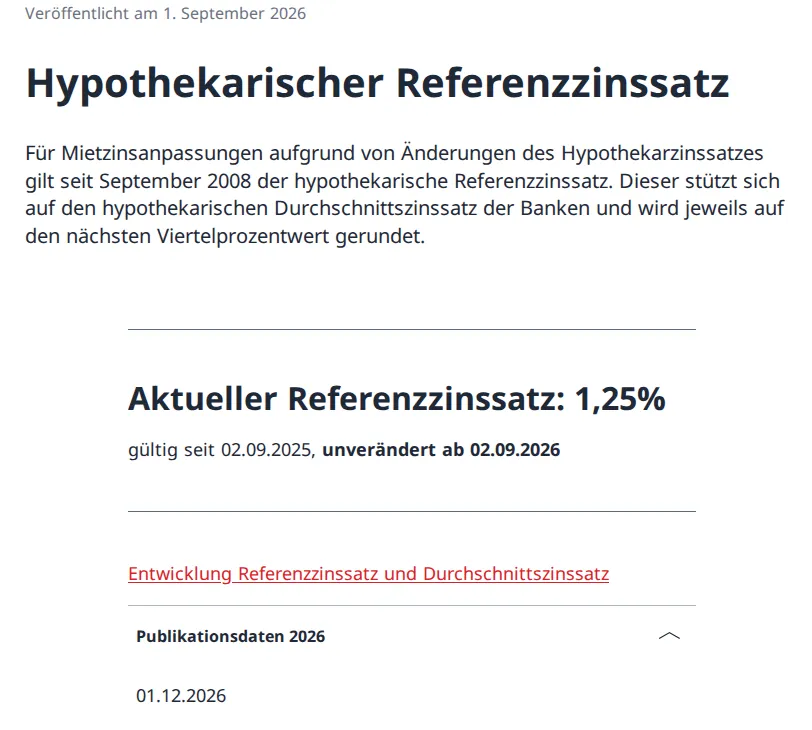
According to the press release of 1 September 2026 (not published in English), the average rate on the reference date of 30 June 2026 was 1.31 percent. The reference rate stays at 1.25 percent until that average falls below 1.13 percent or rises above 1.37 percent. In the last four surveys it was between 1.31 and 1.33 percent, so inside those limits.
The next dates are fixed: 1 December 2026, then 1 March, 1 June, 1 September and 1 December 2027. A new rate applies from the day after it is published. For your claim, though, today's figure matters less than the figure your rent is based on.
Which rate is your rent based on?
What counts is the rate that applied when you signed your lease. If your landlord later raised or lowered the rent because of the reference rate and you did not challenge it, the rate at that last adjustment applies. That is how the FOH's questions and answers put it. You will usually find the figure in your lease, often right next to the net rent, or on the form for your last rent increase.
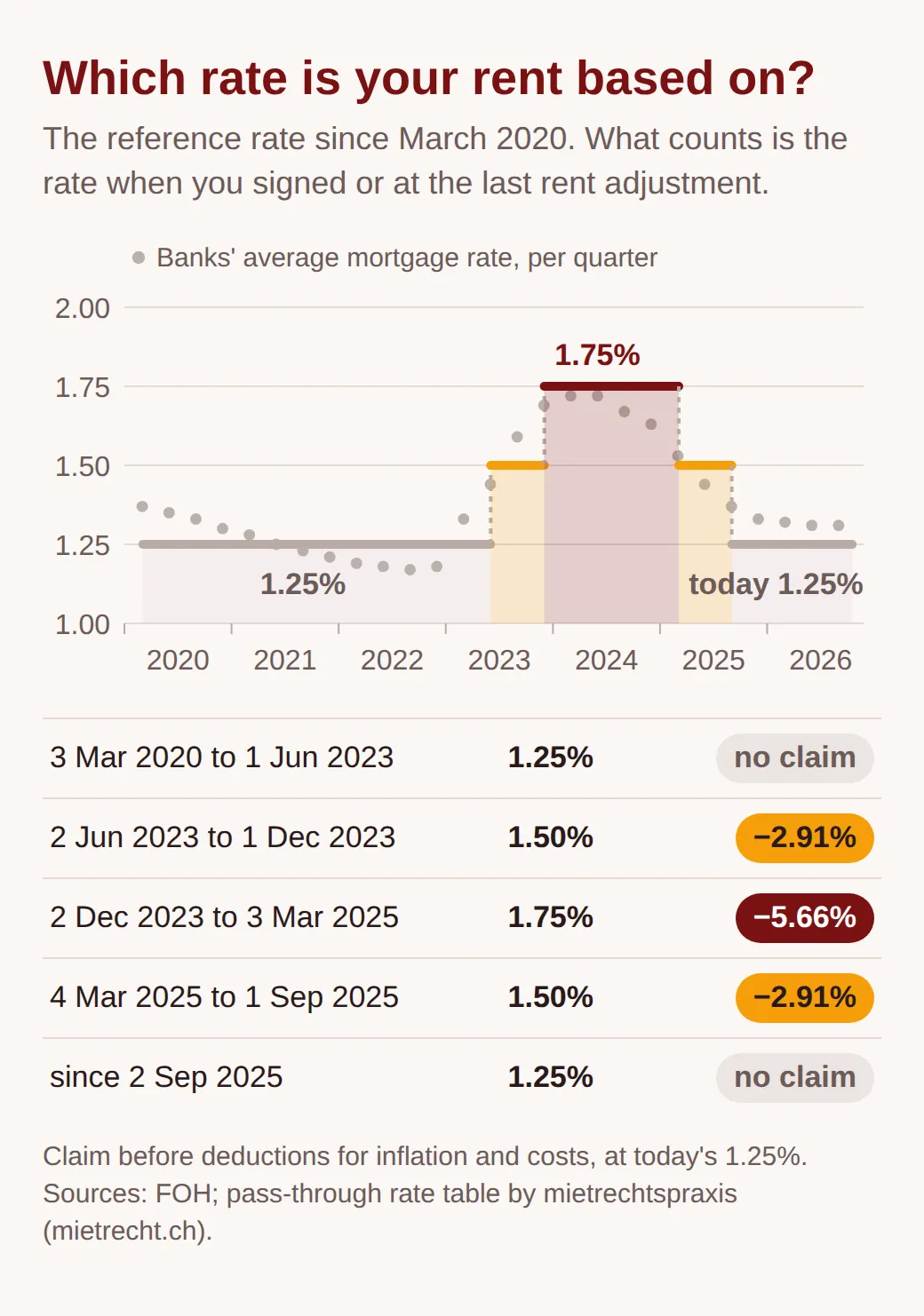
The chart shows why so many tenants have a claim right now. From 2 June 2023 to 1 September 2025 the rate was 1.50 or 1.75 percent. If you signed during that time, or accepted an increase back then, you are often still paying on that basis. If instead you signed between 3 March 2020 and 1 June 2023 and have had no adjustment since, your rent is based on 1.25 percent and you have no claim. Older leases with no later adjustment are based on 1.50 percent or more.
Not every tenancy follows the reference rate. Index-linked rents, which follow the Swiss consumer price index, are excluded, and so are stepped rents, which rise by fixed amounts on set dates. Also excluded are subsidised flats whose rent is controlled by a public authority, and luxury flats and single-family houses with six or more rooms, not counting the kitchen (art. 2 of the tenancy ordinance VMWG, not available in English). If you are in none of these groups and your rent is based on more than 1.25 percent, it is worth doing the sums.
How much less rent are you entitled to?
Each quarter-point cut is worth 2.91 percent of your net rent, and two steps are worth 5.66 percent. The legal basis is art. 13 VMWG: with mortgage rates below 5 percent, a rise of a quarter point allows an increase of at most 3 percent, and when the rate falls, the rent has to come down accordingly.
Why 2.91 and not 3 percent? Because the reduction reverses the earlier increase. A rent of 100 francs rises by 3 percent to 103 francs. To get from 103 francs back to 100, you have to take off 2.91 percent. With two steps, the rent went up by 6 percent, and it comes back down by 5.66 percent. These figures are in the table of pass-through rates published by the journal mietrechtspraxis, which the FOH itself refers to, and the Zurich courts' rent calculator works the same way.
The percentage applies to the net rent only. Heating and other ancillary costs that you pay separately do not change with the reference rate. On a net rent of CHF 1,800, 2.91 percent comes to CHF 52.38 a month, and 5.66 percent to CHF 101.88. That is your gross claim, before your landlord sets anything against it.
What your landlord may deduct
Your landlord may offset the saving against cost increases since the rent was last set. Art. 13 VMWG allows this in the same sentence as the reduction. In practice it comes down to two items: inflation and general costs.
40 percent of inflation
The rent may be adjusted by at most 40 percent of the rise in the Swiss consumer price index (art. 16 VMWG). The starting point is the index level your rent is based on, which is often also in your lease. The conciliation authorities in the canton of Zurich calculate it this way according to their fact sheet on rent increases (in German), and their calculator offsets the same items against a reduction: new index level minus old index level, times 40, divided by the old index level.
Because inflation has been low over the last two years, this item is small at the moment. The index stood at 107.7 points in June 2024 and at 106.9 points in December 2025, both on the base December 2020 = 100. Since then the Federal Statistical Office has used a new base: in September 2026 the index stood at 101.5 points (December 2025 = 100). Converted to the old base (106.9 times 1.015), that is 108.5 points. Make sure both figures in your calculation are on the same base.
The general cost increase
Fees, insurance and maintenance get more expensive, and your landlord may count that too. In principle they have to prove these costs. To keep things simple, the Zurich conciliation authorities work with flat rates per year: 0 percent for new buildings up to five years old, 0.25 percent if many ancillary costs are billed separately, and 0.5 percent if few or none are. In court, on the other hand, a flat rate is only enough in exceptional cases, and documentary evidence is needed. That is set out in the same fact sheet.
These flat rates are Zurich practice. If you live in another canton, ask the conciliation authority in your district how it calculates before you put a figure on your claim. The Zurich courts have a rent calculator online with exactly these flat rates, and the Swiss tenants' association (Mieterverband) has its own; both are in German.
Other objections
Some landlords argue that the property would not earn enough after the reduction. With a reference rate of up to 2 percent, the Federal Supreme Court allows a net return of at most 2 percentage points above that rate, so 3.25 percent today. Whoever relies on an insufficient return has to prove it, and in the case of a reduction that is the landlord, as the Zurich courts point out. Another objection is that the rent is within the range customary in the locality or district. Against a reduction request, that too is for the landlord to prove, with at least five comparable flats in the same place or district, as the Zurich courts write on comparable rents.
Finally, your lease may contain a reservation. If your landlord did not pass on the whole of an earlier increase, they were allowed to record the rest in francs or as a percentage (art. 18 VMWG). A reservation like that can reduce your claim. If there is nothing about it in your lease, there is none.
Worked example: CHF 1,800 net rent
Take a flat whose lease was signed in July 2024 for a start on 1 August 2024. The lease states a net rent of CHF 1,800, a reference rate of 1.75 percent and the consumer price index for June 2024 at 107.7 points. The termination dates in the lease are 31 March and 30 September, with three months' notice. Ancillary costs are paid as a flat fee, so in Zurich the flat cost allowance of 0.5 percent a year applies.
The letter goes out in October 2026 and arrives before the end of December, so the reduction applies from 1 April 2027. The new index level is the one for September 2026, the latest published. The Zurich calculator applies the flat cost allowance pro rata for the months between the two index levels, here June 2024 to September 2026: 27 months, or two years and three months. That gives this calculation:
| Item | Rate | CHF per month |
|---|---|---|
| Reference rate from 1.75% to 1.25% | −5.66% | −101.88 |
| 40% of inflation (107.7 to 108.5 points) | +0.297% | +5.35 |
| Flat cost allowance 0.5% over 2¼ years | +1.125% | +20.25 |
| Total reduction | −4.24% | −76.28 |
The new net rent would be CHF 1,723.72. That is just over CHF 915 less a year, for as long as the lease runs. If the authority uses the lower flat rate of 0.25 percent because many ancillary costs are billed separately, the reduction rises to about CHF 86.40 a month. If the same rent were based on 1.50 rather than 1.75 percent, only about CHF 27 of the CHF 52.38 would be left after the same deductions.
The example shows the order of magnitude, not your amount. Your own figures are in your lease or on your last rent increase notice, and the flat rate depends on your canton.
When does the lower rent apply?
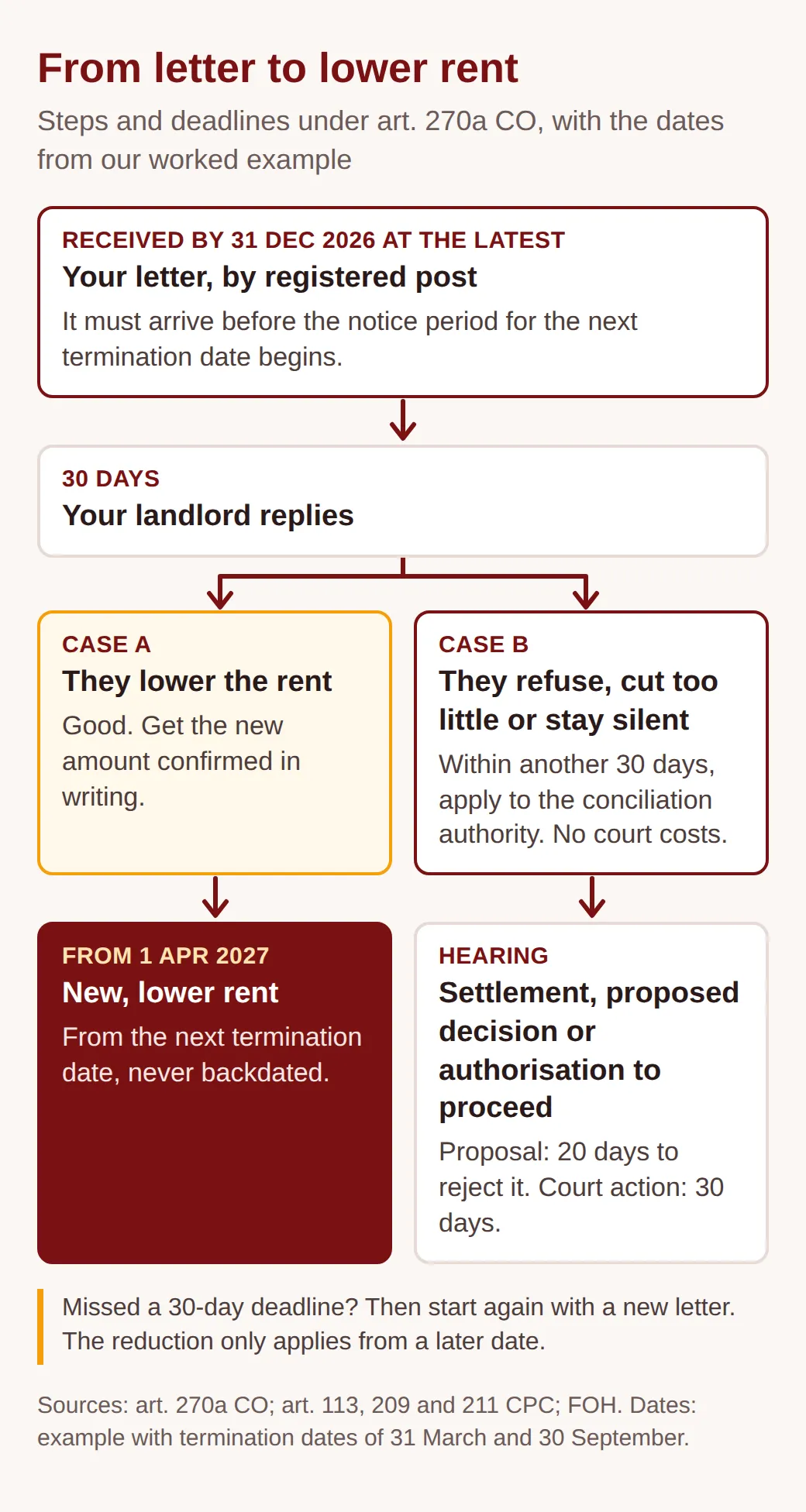
Only from the next possible termination date after your request, as art. 270a of the Code of Obligations says. For flats the notice period is at least three months, to a termination date fixed by local custom (art. 266c CO), unless your lease says otherwise. The next possible date is the one for which the notice period can still be met. Your letter therefore has to arrive before the notice period for that date begins.
In the example, that means: termination date 31 March 2027, three months' notice, so the letter must reach your landlord by 31 December 2026 at the latest. If it only arrives in January, the reduction slips to 1 October 2027, and you overpay for six months longer. So send the letter with a few days to spare.
A reduction is never backdated. If you have done nothing since September 2025, you will not get the overpaid months back. The claim remains, though, as long as your rent is based on a higher rate. That is why the letter is still worth sending now.
How to request a rent reduction
Your request must reach your landlord in writing, and the FOH recommends registered post. State the rate your rent is based on, today's rate, the amount you are asking for and the date from which it should apply. The Zurich courts offer a template in German. If your landlord or agency writes to you in German or French, it makes sense to reply in that language. A shorter version of such a letter could read:
Rent reduction under art. 270a CO
Dear Sir or Madam
The reference interest rate has been 1.25 percent since 2 September 2025. According to my lease of [date], the rent for the flat at [address] is based on 1.75 percent. Taking inflation and the general cost increase into account, I am entitled to a reduction of about [x] percent. I ask you to reduce the net rent accordingly with effect from [date] and look forward to your written reply within 30 days.
Kind regards
Your landlord then has 30 days to reply. They can agree, refuse, or offset the reduction against higher costs. If they offset it, ask for their calculation so that you can compare the items with your own. The chart shows what happens from there.
If your landlord refuses the reduction
If your landlord does not reply, refuses, or cuts the rent by less than you asked, you can go to the conciliation authority within 30 days. The FOH errs on the side of caution: your application should reach the authority no later than 60 days after your original letter. If you miss that deadline, you start again with a new letter, and the reduction only applies from a later date.
The authority responsible is the joint conciliation authority for tenancy matters where the flat is, made up of a chairperson and one representative each of tenants and landlords. The FOH links to their addresses (in German). Your application names the other party, what you are asking for and what the dispute is about. You can also make it orally and have it recorded. Conciliation proceedings in tenancy disputes cost no court fees (art. 113 of the Civil Procedure Code), and neither party is ordered to pay the other's costs there either.
At the hearing, the authority first tries to reach a settlement. If that fails, it can make a proposed decision. If neither party rejects it within 20 days, it has the effect of a binding decision (art. 211 CPC). Otherwise one party receives authorisation to proceed and has 30 days to take the case to the rental court (art. 209 CPC). Until the proceedings end, your existing lease carries on unchanged.
Many tenants hold back for fear of losing their flat. A notice given because you assert a claim in good faith can be challenged, as can one given during proceedings and, in many cases, up to three years afterwards (art. 271a CO). The protection is not absolute, for example in the case of rent arrears or the landlord's urgent need to use the property.
What to do now
Dig out your lease and your last rent increase notice today and look for two figures: the reference rate and the index level. If it says 1.50 or 1.75 percent, work out your claim with one of the calculators and check the termination dates in your lease. If your dates fall at the end of March, your letter has to arrive this year.
On 1 December 2026 the FOH publishes the next rate. If it does fall at some point, you can ask for another reduction, so waiting gains you nothing. For the case where the rate one day rises above 2 percent, the Federal Council in September 2026 (in German) asked the Federal Department of Economic Affairs, Education and Research to propose a rule on the permitted return for the ordinance by April 2027. For your reduction request today, that changes nothing.
Common questions
Can I get back the rent I overpaid since the reference rate fell?
No. A reduction only applies from the next termination date after your request and is never backdated. The months you paid on the old basis are lost. The claim itself does not expire, though: as long as your rent is based on 1.50 percent or more, you can make it at any time.
Can my landlord give me notice for asking for a rent reduction?
You can challenge a notice given because you assert claims under your lease in good faith. A notice given during conciliation or court proceedings can also be challenged, and so can one given up to three years afterwards if your landlord lost a substantial part of the case or reached a settlement with you. There are exceptions, for example rent arrears or the landlord's urgent need to use the property.
Does the reference rate reduction also apply to commercial premises?
Yes. The Federal Office for Housing explicitly mentions tenants of both residential and commercial premises. As with flats, index-linked and stepped rents are excluded. The 30-day deadlines and the route through the conciliation authority are the same. Commercial leases are terminated with six months' notice, though, so your letter has to arrive correspondingly earlier.
I signed my lease after September 2025. Can I still get my rent lowered?
Not through the reference rate, because your rent is then based on today's 1.25 percent. You can only challenge the initial rent in narrow cases, for example if it was raised significantly compared with the previous tenant, or if you had to sign because of personal hardship or a tight housing market. For that you have only 30 days from moving in.
What happens to my rent if the reference interest rate goes up again?
Your landlord may then raise a rent based on a lower rate by 3 percent per quarter point. They have to use a form approved by the canton and notify you at least ten days before the notice period begins. You can challenge such an increase at the conciliation authority within 30 days.
More from the blog
All posts
Minimum temperature in a Swiss rented flat: your rights
No legal minimum temperature, just reference values: 20 °C living room, 17 bedroom, 23 bathroom. What they mean for tenants and what to do if it stays cold.

Flat handover in Switzerland: defects list, deadline, photos
Moving into a rented flat in Switzerland: what goes in the move-in report, when to send your defects list and which photos save you money at move-out.

How to challenge a landlord's notice in Switzerland
Notice from your landlord? You have 30 days from the collection slip. Void without the official form, set aside if abusive, extensions of up to four years.