How to challenge a landlord's notice in Switzerland

The deadline comes first
You challenge a notice from your landlord at the conciliation authority where the flat is, within 30 days of receiving it, and the procedure there costs nothing. Without the official form, the notice is void. If the reason is abusive, it is set aside. If it is valid, the lease can be extended by up to four years in the same procedure.
The 30 days are strict: miss them and you lose the right for good, as the Zurich courts (in German) put it. And they often start earlier than you'd think: not when you collect the registered letter, but when the yellow collection slip lands in your letterbox.
When do the 30 days start?
The deadline starts on the day after you receive the notice. If you don't collect a registered letter straight away, the notice usually counts as received on the day after the collection slip was left, not at the end of Swiss Post's seven-day collection period.
A case from Carouge near Geneva shows how harsh this rule is. A tenant had lived in a four-room flat since 1995, most recently paying CHF 942 a month. At the end of November 2013 the owner gave her notice for the end of March 2014, on the official form and by registered post. On 2 December the collection slip was in her letterbox. She was away for about ten days, found the slip only on 9 December, too late in the day for the post office, and never collected the envelope. In February 2014 she challenged the notice. Too late, the Federal Supreme Court ruled in the leading case BGE 143 III 15: the notice counted as received on 3 December.
Being on holiday makes no difference. According to the ruling, if you find a collection slip after being away, you have to ask the post office who sent the letter and, if need be, ask the landlord for a copy. The deadline still runs from the original date, so you may only have a few days left. The owner's stated reason for the notice, by the way, was that he wanted to re-let the flat at the higher rent usual in the neighbourhood. Whether that was abusive was never examined.
This is stricter than for a rent increase. For notice of an increase, and for the payment deadline when rent is in arrears, the Federal Supreme Court makes an exception: there an uncollected registered letter only counts as received on the seventh day of the collection period. How that works for an increase is explained in our article on challenging a rent increase.
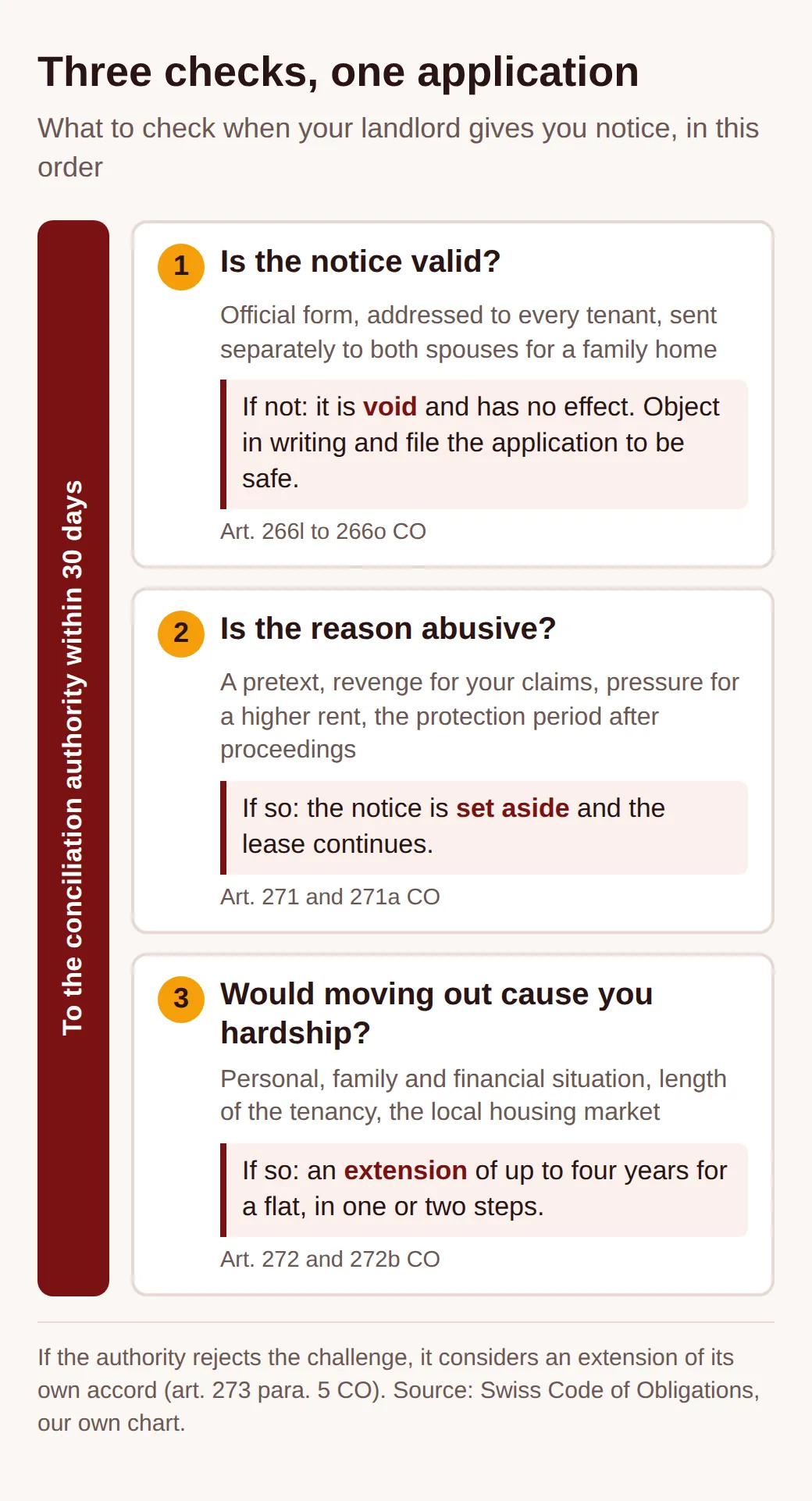
If day 30 falls on a Saturday, a Sunday or a public holiday, the deadline ends on the next working day (art. 78 CO). Even so, don't count on the last day. What you check within these 30 days comes down to three questions, and all three go into the same application.
Is the notice valid at all?
A landlord's notice is only valid if it comes in writing on a form approved by the canton (art. 266l CO). Without the form, it is void (art. 266o CO). So a letter without the form, an email or a text message does not end your tenancy.
What the form must contain is laid down in art. 9 VMWG, the federal ordinance on tenancy law (not available in English): the flat concerned, the date on which the lease is to end, a statement that reasons must be given on request, the rules on challenging the notice and on extensions, and the list of conciliation authorities. Each canton approves its own forms. In the canton of Zurich, landlords may also use their own forms, but only if the Department of Justice and Home Affairs has approved them beforehand. Such a form then carries a note of approval, as the canton's forms page (in German) states.

Not every flaw makes a notice void. In the leading case BGE 140 III 244, landlords in the canton of Vaud had used an older version of the cantonal form, and the Federal Supreme Court let the notice stand. What matters is whether the form does its job, which is to tell you about your rights. A wrong date does not invalidate a notice either. If it does not respect the notice period or the termination date, it simply takes effect on the next possible date (art. 266a CO). The statutory notice period for flats is three months, to a termination date customary in the locality (art. 266c CO), unless your lease says otherwise.
Some other mistakes also make a notice void. On their page on void notices (in German), the Zurich courts list, among others: the notice is not addressed to all the tenants, it is not given by all the landlords, it covers only part of what you rent, such as taking a cellar compartment out of the lease, or it depends on a condition that is not entirely in your hands.
If you live in the flat with your spouse or registered partner, another rule applies. The notice must be served on each of you separately (art. 266n CO), so in two envelopes. That applies even if only one of you signed the lease. If only one copy arrives, the notice is void. Your partner can also challenge it in their own right and ask for an extension (art. 273a CO).
A void notice has no effect, even if you do nothing. Still, don't rely on that. The Zurich courts advise objecting in writing and, to be on the safe side, asking the conciliation authority within 30 days to establish that the notice is void. If the form is in order, the next question is the reason.
When is a notice abusive?
A notice is abusive if it breaches the principle of good faith (art. 271 CO). That sounds broad but is narrow in practice: a landlord needs no particular reason for an ordinary notice. According to the Zurich courts, any reason that is meant seriously can support one.
In the leading case BGE 142 III 91, the Federal Supreme Court drew the line like this: a notice breaches good faith if it is given without an objective, serious interest worth protecting, in other words purely to harass, or if the interests of the two sides are grossly out of proportion. That the notice hits you hard is not enough. Hardship only counts when it comes to an extension. Permissible reasons, according to BGE 148 III 215, include the landlord's own use, a renovation, a different use of the premises and even the wish for a higher return, as long as it stays within the law.
That is why the most important step is finding out the reason. The landlord must give reasons for the notice if you ask. Missing or patchy reasons do not in themselves make a notice abusive. But according to BGE 148 III 215 they are a sign that there is no interest worth protecting or that the reason is just a pretext. And a pretext breaches good faith, for example claiming own use when a renovation is really planned and the landlord wants to avoid a long extension. The Zurich courts offer a template (in German) for the request. Kept short, this is enough:
Notice of [date], flat at [address]
Dear Sir or Madam
I received your notice on [date]. Under art. 271 para. 2 CO, I ask you to tell me the reason in writing.
Yours faithfully
The landlord does not have to reply within your 30 days, but the deadline keeps running. So don't wait for the reply before filing your application. No reply, or a thin one, is an argument in your favour before the conciliation authority.
What the law expressly rules out
For certain cases, the law itself says that the notice can be challenged (art. 271a CO). The best known is the retaliatory notice: the landlord gives notice because you assert claims in good faith, such as a rent reduction based on the reference interest rate or the repair of a defect. A notice can also be challenged if the landlord uses it to force through a higher rent or another change to the lease to your detriment, or if its only purpose is to get you to buy the flat.
On top of that comes a protection period. A notice can be challenged during conciliation or court proceedings about the tenancy, and for three years afterwards if the landlord largely lost, withdrew their claim or reached a settlement with you. The three years also apply after a settlement reached outside any proceedings, if you can prove it with documents. So keep such letters and emails.
The protection period does not cover everything. It does not apply in cases of urgent own use, rent arrears, a serious breach of the duty of care, a sale of the property, good cause or bankruptcy. Two reasons deserve a closer look: renovation and own use.
Notice because of a renovation
A notice for a major renovation is allowed if your presence would make the work considerably harder, more expensive or slower. It is abusive if, when notice is given, the project is not yet far enough along for you to judge whether you really have to move out, or if it would obviously never be approved (BGE 140 III 496). A building permit, however, does not have to be in place yet.
Two leading cases show where the line runs. In BGE 142 III 91, the notice for a shop in the Bernese Oberland said an architectural competition was under way and the landlord wanted to keep all options open. That was not enough, and the Federal Supreme Court set the notice aside. In BGE 148 III 215 from the canton of Vaud, by contrast, a tenant had lived in a two-room flat since 1996, most recently paying CHF 685 net. The new owner, a company, gave notice in order to renew the bathroom, kitchen, floors and walls and remove asbestos, for CHF 32,000 to 35,000 and 45 to 60 days of work. The work was not urgent. The Federal Supreme Court let the notice stand all the same: whoever owns a property may decide which work is carried out. The tenant was granted a first extension of two years.
Own use and a sale
If the landlord wants to move in or let close relatives have the flat, that is a permissible reason. But only urgent own use has a special effect: only it overrides the protection period, and only it allows a new owner to give notice early. A change in the law would have replaced "urgent" with "significant and current on an objective assessment". Voters rejected it on 24 November 2024, with 53.8 percent voting no (Swissvotes), so the law still says "urgent".
If the building is sold, your lease passes to the new owner (art. 261 CO). The new owner can only give notice earlier than the lease allows by claiming urgent own use, and then only with the statutory notice period to the next statutory termination date. If that causes you a loss, the former landlord is liable. And if the reason holds up, you still have the extension.
Extension: more time, even if the notice stands
Even a valid notice that is not abusive does not have to force you out of the flat on the date it names. You can ask for an extension if moving out would cause you or your family hardship that the landlord's interests do not justify (art. 272 CO).
The authority weighs the two sides against each other. It looks at the lease and how it came about, how long the tenancy has lasted, the personal, family and financial situation of both parties, any need for own use and how urgent it is, and the local housing market. The lease on a flat can be extended by at most four years, on business premises by six, in one or two steps (art. 272b CO). If you agree on an extension directly with the landlord, there is no maximum.
For an open-ended lease, the application for an extension also goes to the conciliation authority within 30 days of receiving the notice (art. 273 CO). If you challenge the notice, you don't need a separate application: if the authority rejects the challenge, it considers an extension of its own accord. The Zurich courts (in German) still advise asking for both if in doubt, because abusive motives often only come to light during the proceedings.
An extension is ruled out if notice was given because of rent arrears, a serious breach of the duty of care or bankruptcy (art. 272a CO). The same goes for a lease expressly concluded only until a renovation starts. As a rule it is also ruled out if the landlord offers you an equivalent replacement flat.
Making use of the extra time
During the extension your lease carries on unchanged unless the decision adjusts it. If you find something sooner, you don't have to stay until the end: with an extension of up to one year you give one month's notice to the end of a month, with a longer one three months' notice to a statutory termination date (art. 272d CO), unless the decision or the agreement says otherwise.
If you want a second extension, you must ask for it no later than 60 days before the first one runs out. The authority then also considers whether you have done everything that could reasonably be expected of you to find a new flat. The Zurich courts call records of your search the best proof of hardship. So keep every application, every rejection and every viewing, from the first month on.
How to challenge the notice
The procedure starts with an application to the joint conciliation authority where the flat is. In it you name the other party, what you are asking for and what the dispute is about, either in writing or orally for the record (art. 202 CPC). The Federal Office for Housing (in German, French and Italian) links to the addresses, and the canton of Zurich has an online form (in German) for it. Conciliation proceedings in tenancy disputes carry no court fees, and neither side has to pay the other's costs (art. 113 CPC).
Ask for the most far-reaching outcome first and the more modest ones as fallbacks. That is how the tenant's claim in the Bern case was worded: declare the notice void, or failing that set it aside as abusive, or failing that extend the tenancy. The hearing takes place within two months (art. 203 CPC). The authority, made up of a chair and one representative each from the tenants' and the landlords' side, first tries to reach an agreement.
The federal statistics show how often that works. In the second half of 2025, ordinary notice was the most common subject of closed conciliation cases, with 2,561 cases or 14.78 percent of all cases closed, according to the Federal Office for Housing's report (in German). Of the cases it breaks down by outcome, three in four ended in agreement.
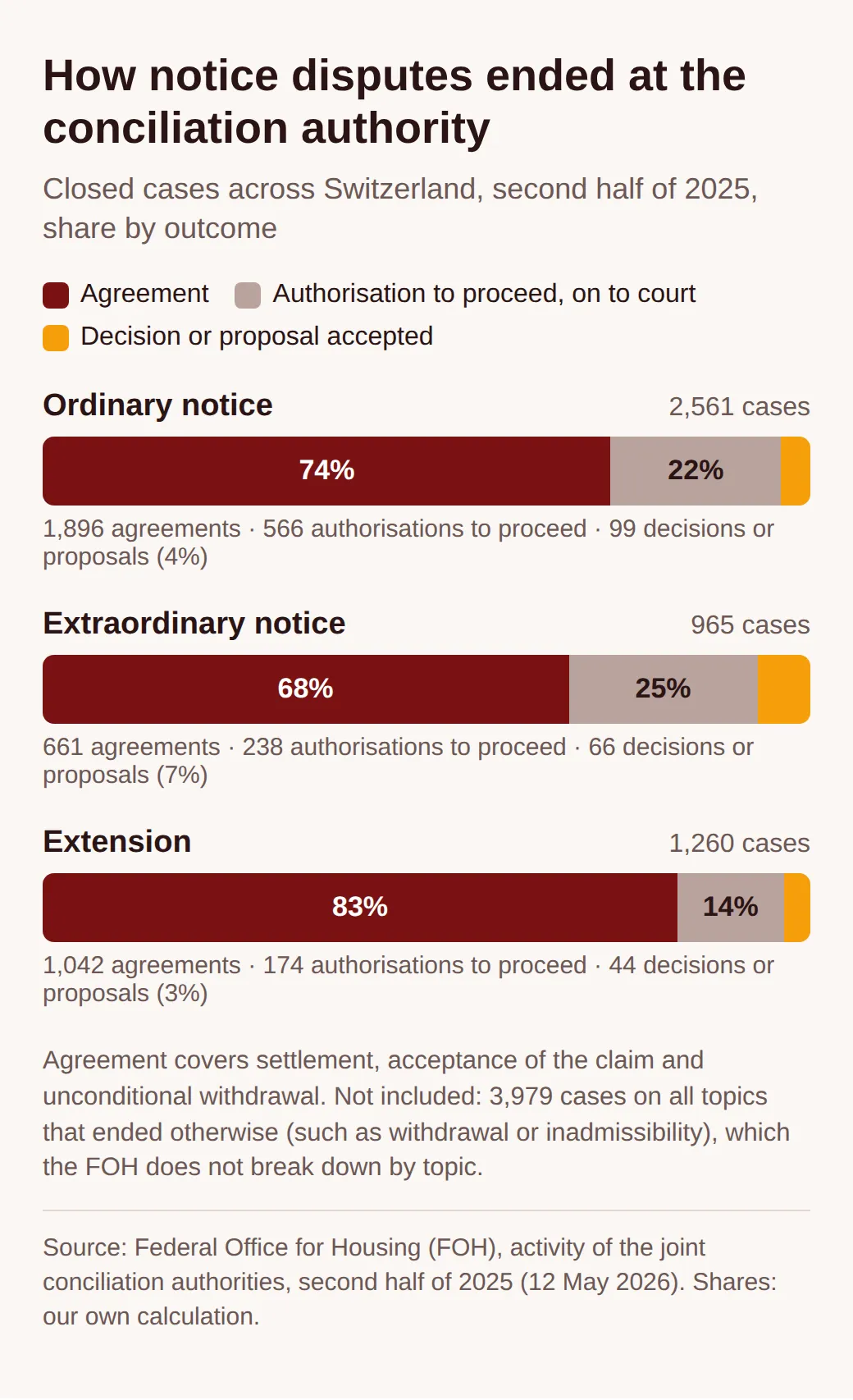
An agreement does not mean you have won. The office counts settlements, acceptance of a claim and unconditional withdrawals as agreements. Who got what is not in the statistics. In the canton of Zurich, 543 of 728 cases about ordinary notice ended in agreement, close to the national average.
If the parties do not agree, the authority can make a decision proposal (art. 210 CPC). If neither side rejects it within 20 days, it has the effect of a binding decision. For notices this has an important consequence: whoever rejects the proposal must go to court within 30 days, otherwise the proposal counts as accepted (art. 211 CPC). In the Vaud case, the authority proposed setting the notice aside. The owner rejected the proposal and so had to go to court itself. If there is neither an agreement nor a proposal, you receive the authorisation to proceed and also have 30 days to file a claim (art. 209 CPC). Let them pass, and the notice stands.
The exception: notice for rent arrears
If you don't pay the rent, different rules apply, and they are harsher. The landlord must first set you a written deadline of at least 30 days to pay and warn you that the lease will be terminated otherwise (art. 257d CO). If you don't pay within that time, the landlord may give at least 30 days' notice to the end of a month.
In that case there is no extension, and the protection period does not help you. You can still challenge the notice within 30 days, for example if the payment deadline was too short, the notice came too early or, for a family home, the warning was not sent separately to both spouses. But the most effective protection is to pay within the deadline. Then the landlord may not give notice at all.
When the registered letter is waiting for you
Collect it the next day and write down the date on the collection slip. Count 30 days from the day after and put the end date in your diary, with a few days to spare. Next, check the form, who it is addressed to and, if you are married, the two envelopes. Ask in writing for the reasons, without waiting for the reply.
After that, file the application, with the challenge and the extension together, even if you are not yet sure. It costs nothing, and you can always withdraw it later. A missed deadline cannot be made up. And if you are unsure, ask the conciliation authority itself: in tenancy matters, the law makes it a legal advice office as well (art. 201 CPC).
Common questions
Can my lease say I give up protection against termination?
No, such a clause does not apply. You can only waive protection against abusive notice and the right to an extension where the law expressly allows it, and any agreement to the contrary is void. The one exception is an extension you negotiate with the landlord yourself: there you can give up a second extension.
Can I stay longer if I have a fixed-term lease?
A fixed-term lease ends without notice, so there is nothing to challenge. You can still ask for an extension if moving out would cause you hardship. You file that application with the conciliation authority no later than 60 days before the lease ends, not within 30 days.
Are subtenants in Switzerland protected against termination?
Yes, as long as the main lease is still running. An extension, however, is only possible until the main lease ends. If the sublease mainly serves to get around protection against termination, subtenants are protected regardless of the main lease, and if the main lease is terminated, the landlord takes the place of the main tenant.
Can my landlord give me notice because my partner moves in or we have a baby?
A notice given because of a change in your family can be challenged if the change causes the landlord no significant disadvantage. The law says so expressly. Whether there is such a disadvantage is for the conciliation authority to decide if it comes to a dispute.
More from the blog
All posts
Flat handover in Switzerland: defects list, deadline, photos
Moving into a rented flat in Switzerland: what goes in the move-in report, when to send your defects list and which photos save you money at move-out.

Minimum temperature in a Swiss rented flat: your rights
No legal minimum temperature, just reference values: 20 °C living room, 17 bedroom, 23 bathroom. What they mean for tenants and what to do if it stays cold.

Subletting in Switzerland 2026: consent, rent and Airbnb
Subletting in Switzerland: when your landlord can say no, what you may charge for a room, the rules for Airbnb and who is liable. With real court cases.