Subletting in Switzerland 2026: consent, rent and Airbnb

The short answer
Yes, you may sublet all or part of your flat in Switzerland, but only with your landlord's consent. The landlord can say no for only three reasons: if you keep the terms from them, if the rent you charge is abusive, or if the sublet causes them major disadvantages. A ban in your lease does not apply.
This has been the law since 1990, and nothing has changed. The stricter rules Parliament passed in 2023 were rejected at the ballot box in November 2024. Court cases show where the limits lie better than any summary. There is the Geneva flat sublet for almost three times its rent, the tenant who deleted her Airbnb listing just in time, and the tenant who went all the way to the Winterthur Rent Tribunal over weekend guests.
What the law allows
The rule is in Art. 262 CO and it is short: you can sublet all or part of what you rent with your landlord's consent, and the landlord can refuse only for the three reasons above. That covers a single room in your flat just as much as the whole flat while you spend a semester abroad.
This rule is mandatory. A clause in your lease that rules out subletting is invalid, as the fact sheet by mietrechtspraxis (in German) states. The canton of Basel-Stadt publishes it online together with a contract template. The Federal Supreme Court took the same view in a Geneva case from 2008 (in French): a clause that allowed subletting only in the three summer months could not ban it for the rest of the year. A clause that requires the request and the consent to be in writing is allowed, though, as long as it does not turn into a hidden ban. The Winterthur Rent Tribunal said so in the Airbnb case we come to further down.
The law itself does not require any particular form. Consent can be given in writing, orally or tacitly, for example when the landlord accepts a sublet after the fact. That is how the legal guide of the federal Service for Combating Racism (in German) describes it. Only a letter will help you in a dispute, so it is best to ask in writing.
If you have read something different, you probably came across the reform put to the vote on 24 November 2024. The text of the law (in German) would have required written consent, the names of the subtenants in the request, a new ground for refusal for sublets of more than two years, and termination with at least 30 days' notice after an unheeded written warning. The proposal won 48.4 percent of the vote and was therefore rejected. So the old article with its three grounds still applies.
When can a landlord refuse a sublet?
Only if one of the three grounds applies, and it has to apply in the specific case. The Zurich courts sum up the Federal Supreme Court's case law on their page on the conditions for subletting (in German).
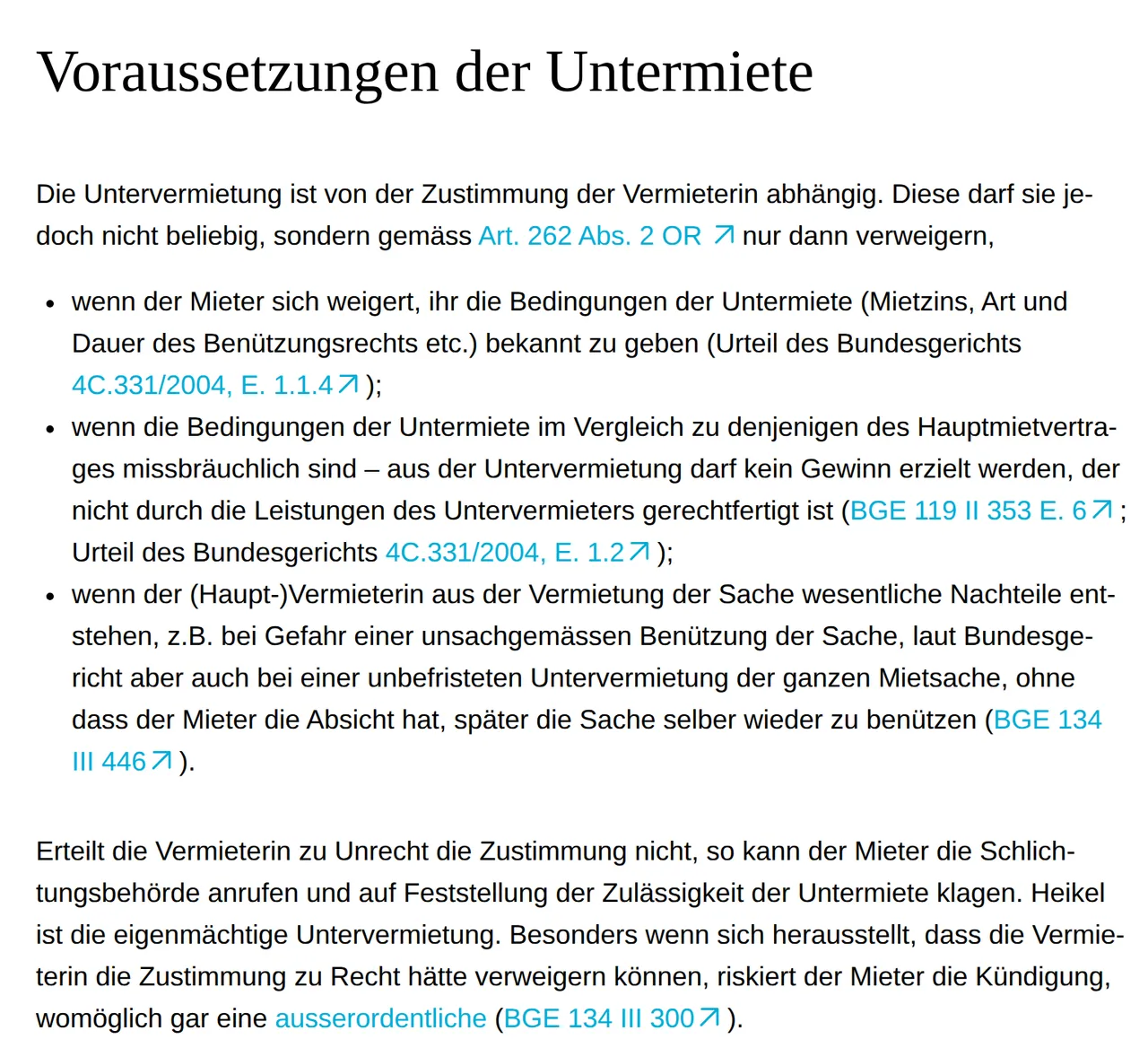
You keep the terms to yourself
Your landlord is entitled to know who you are subletting to, at what price, for how long and for what use. If you refuse to give these details, they may say no. In practice, you attach the draft sublease to your request, and that covers everything.
The rent you charge is abusive
Subletting must not earn you a profit that your own services, such as furniture or cleaning, do not justify. We show how to calculate this further down. Two of the Geneva cases in this post failed on exactly this point.
The sublet causes the landlord major disadvantages
This means a use that puts more strain on the building than agreed: an overcrowded flat, a rehearsal room, a business with lots of customers, illegal activities, or noise the neighbours complain about. The subtenant's origin, ethnicity or religion is not a ground, though: a refusal for those reasons has no legal effect, as the federal legal guide states.
If the landlord says no without one of these grounds, you can go to the conciliation authority and have it confirmed that the sublet is allowed. However, the Federal Supreme Court also counts as a major disadvantage a case that affects everyone who moves out with no plan to return.
Moving out for good
Subletting is meant for tenants who do not need their flat for a while or for whom it has become too big. The Federal Supreme Court gives as examples a fixed-term stay abroad for work and a flat that family members have moved out of or where they have died (BGE 138 III 59, in German). A tenant who has no intention of ever moving back, on the other hand, is using the sublet to install a successor as if they owned the flat. That is an abuse of rights, and the right to sublet then does not apply.
The case behind this comes from Geneva. In 1999 a tenant moved out of a 3-room flat and left it to her adult son. Later his wife moved in, the couple separated, and a court gave the flat to the daughter-in-law. The tenant asked the property manager whether the lease could be transferred to her son and then to her daughter-in-law. That was her undoing: someone who wants a transfer does not want to come back. The Federal Supreme Court upheld the termination after almost seven years of subletting (BGE 134 III 446, in French).
The bar is high. According to the Federal Supreme Court, a vague chance of perhaps coming back one day is not enough. If a tenant challenges an ordinary notice of termination, she has to prove that she meant to return. Evidence could be a fixed-term employment contract abroad or a place on a course with a fixed end date.
There is a way out for anyone who is leaving anyway. If you have already given notice on the flat and only want to sublet until the end of your lease, the landlord may not say no, according to the mietrechtspraxis fact sheet. If you want to leave the lease earlier, you are better off proposing a replacement tenant who takes over the lease (Art. 264 CO). That leaves the question of what you may charge for a room or a flat.
How much rent can you charge a subtenant?
As much as your share of the rent plus the extra services you provide. The yardstick is your own rent, not the market rent in the neighbourhood. The Federal Supreme Court ruled this in 1993 in its leading case BGE 119 II 353 (in French), and it applies even if you sublet only one room and all the sublets together do not add up to more than your rent.
The case: a tenant in Geneva wanted to sublet two furnished rooms of her 4½-room flat. Her rent was CHF 1,575 plus CHF 204 in ancillary costs, and the subtenants could use the kitchen only to make coffee and the washing machine not at all. The court divided the rent by the rooms excluding the kitchen, so by 4.5, and arrived at CHF 395.35 per room. It added 20 percent for furniture and risk, took off 20 percent for the kitchen and washing machine, and added CHF 57 for electricity, telephone and cleaning. The result: CHF 452.35. By the court's calculation, the tenant wanted to charge CHF 601.80 and CHF 627, that is 33 and 39 percent more. The Federal Supreme Court called differences of 30 to 40 percent clearly abusive and found for the landlord.
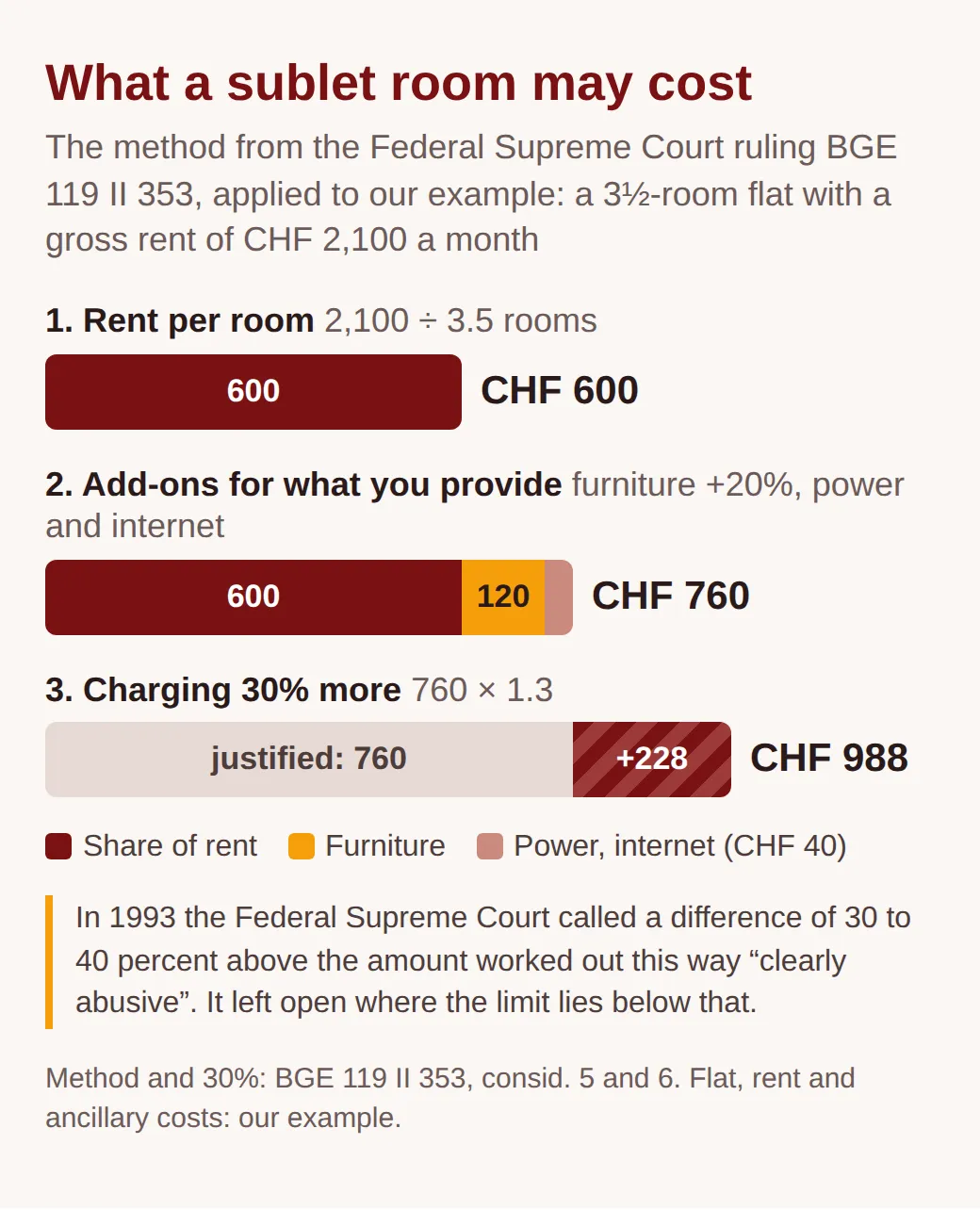
Applied to a flat today, it looks like the chart. With a gross rent of CHF 2,100 and 3½ rooms, one room costs CHF 600. If it is furnished, 20 percent is added. There is no deduction for the kitchen if the subtenant shares the kitchen and bathroom. The mietrechtspraxis fact sheet sets a furniture surcharge based on value and lifespan, as a rule at most 20 percent of the sublet rent. Add a share for electricity or fees, here CHF 40, and you get CHF 760. Anyone charging CHF 988 is 30 percent above that, which is where the Federal Supreme Court spoke of abuse. The court left open exactly where the limit lies below that. But the law has no place for profit with nothing given in return.
The extreme cases are clear. A married couple in Geneva paid CHF 4,220 including ancillary costs for an 8-room flat and sublet it furnished for CHF 12,000 a month, almost three times as much. Even with furniture, that was clearly abusive. The same calculation applies to letting by the day: according to a reply by the Zug cantonal government (in German) from 2020, the Zurich Rent Tribunal ruled in 2017 that CHF 220 a day was abusive for a furnished, cleaned flat whose main rent came to no more than CHF 100 a day. Which brings us to short-term holiday lets.
Airbnb and other short-term lets
The same rules apply to Airbnb and similar platforms as to any other sublet. So as a rule you need consent for each letting, unless your landlord gives you general permission to sublet of their own accord, and they may say no on the same three grounds. There is no special rule: in 2018 the Federal Council proposed writing a general consent for repeated short sublets into the ordinance, and on 8 March 2019 it dropped the idea (in German).
A first-instance ruling by the Winterthur Rent Tribunal (in German) of 2 April 2025 shows what this looks like in practice. A tenant of a 2½-room flat with a gross rent of CHF 1,844 wanted to let it on Airbnb for two years, on 6 to 9 days a month. The property manager refused, he sued and lost on every point. First, nobody is entitled to general consent for future guests whom no one knows yet. The landlord may check each sublet, and two to four weeks should be enough for that, even if this is impractical for short-notice bookings. Second, the court saw regular letting meant to cover a good part of the rent as commercial use. Third, guests almost every weekend mean more wear and more noise, and a neighbouring family had already complained. That is a major disadvantage. The tenant bore CHF 3,300 in court costs and had to pay the landlord CHF 4,100 in legal costs.
This does not mean that every let through a platform is banned. The same three grounds count: a rent no higher than your share of the rent plus your services, full disclosure, and a use that puts no more strain on the building than your own living there. The more regularly and the more expensively you let, the weaker your position. The Zurich courts also point to a decision published in 2017 in which the Zurich Rent Tribunal had a tenant banned from letting through booking platforms altogether, after abuses involving the rental income and disorder in the building.
Alongside tenancy law, public law applies, and cantons and municipalities handle it differently. In the canton of Zug, for example, the government's 2020 reply said that an accommodation levy had applied to Airbnb lets since 2017 and that hosts had to have every guest fill in a registration form. The Zug government and the Winterthur court took different views on whether regular short-term letting is allowed in a purely residential zone. So ask your municipality about tourist tax, registration duties and zoning rules before you post your first listing.
Subletting without permission: what happens next?
You risk losing the flat, but not straight away and not in every case. A sublet without consent allows the landlord to give extraordinary notice of at least 30 days to the end of a month under Art. 257f CO, if five conditions are all met. The Federal Supreme Court listed them in ruling 4A_140/2019 (in French): a breach of duty, a written warning, that you carry on anyway, that continuing the lease is unreasonable for the landlord, and the 30-day notice period to the end of a month.
The first condition is the crux. There is only a breach of duty if the landlord could have refused the sublet on one of the three grounds. If so, continuing the lease automatically counts as unreasonable. In the Geneva case with the CHF 12,000 sublet, the couple did not respond to the warning and even denied in court that they were subletting at all. The termination was valid (BGE 134 III 300, in French).
What happens after the warning is decisive. The case traced in the chart shows this: a tenant in Geneva offered her flat on Airbnb for over a year without asking. After the warning, one booking of four nights still went ahead, and then the listing was gone. That was enough. Because she had stopped within a reasonable time, the extraordinary notice was invalid.
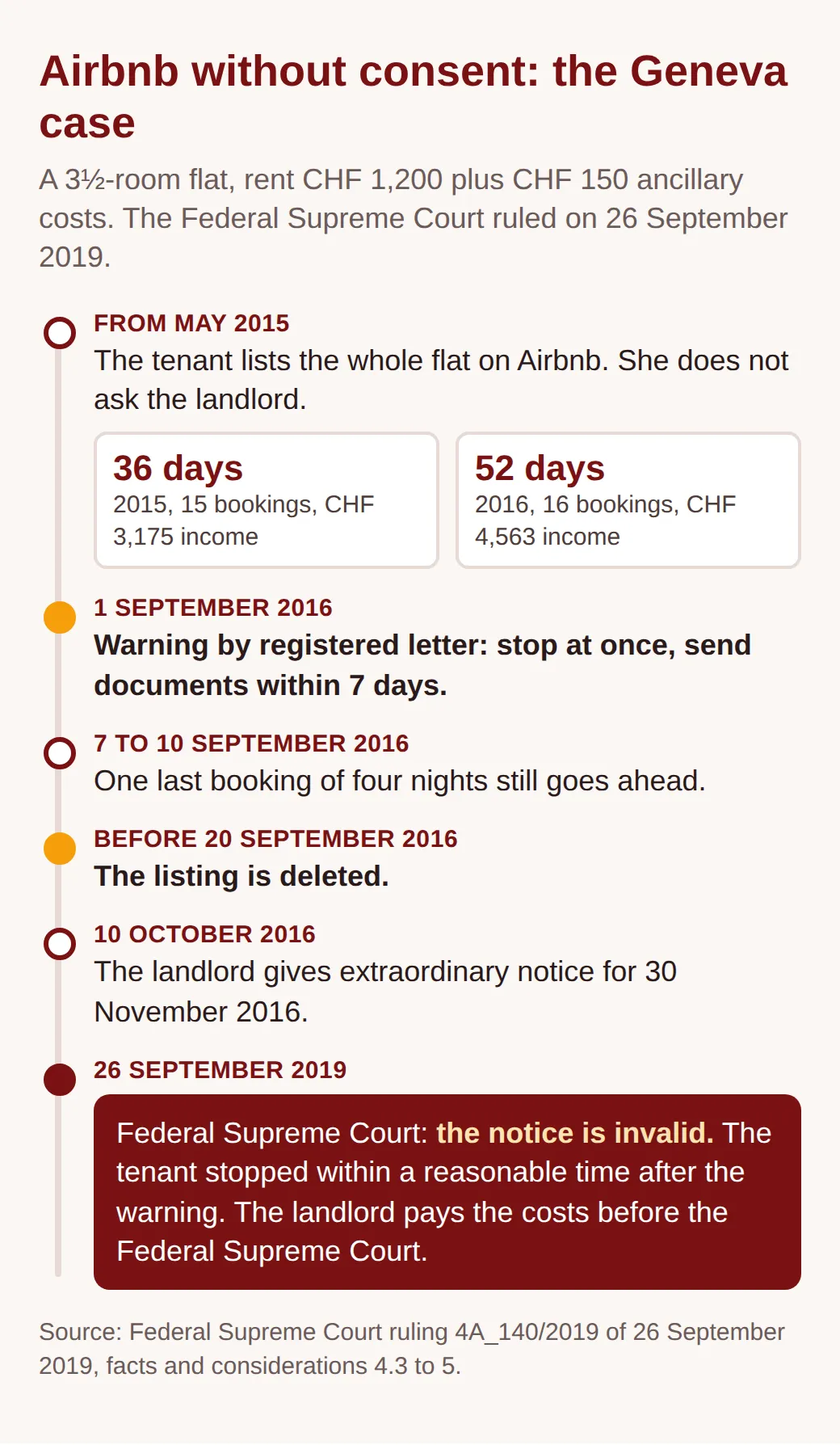
That does not get you off the hook completely. An ordinary notice for the next termination date needs no particular reason, as long as it does not breach good faith. In BGE 138 III 59, the Federal Supreme Court considered it possible that a sublet without asking could damage trust so badly that such a notice holds up. On the other hand, you are protected if you ask properly: you can challenge a notice given because you asserted your right to sublet under Art. 271a CO. Once you have consent, you switch sides and become a landlord yourself.
What to watch out for as a sublandlord
A sublease is an ordinary lease, and in it you are the landlord. All the rules that protect tenants therefore also apply against you, as the Zurich courts explain on their page about the sublease (in German).
This has consequences that many people overlook. In cantons where an official form is required for the initial rent, such as Zurich, you have to use the official form too. Any notice of termination you give must be in writing and on the form approved by the canton (Art. 266l CO). If your landlord raises your rent and you want to pass this on to your subtenant, you cannot simply forward their form. You need your own, with your own justification. How a rent increase has to be justified is explained in our post on challenging a rent increase.
The notice periods are the same too. You give your subtenant at least three months' notice for a sublet flat (Art. 266c CO), and two weeks' notice to the end of a one-month rental period for a furnished room (Art. 266e CO). Your subtenant only owes ancillary costs that are listed one by one in the contract; otherwise they are included in the rent. Our post on the ancillary costs statement shows how to check one. And if the room has a defect, your subtenant's claims are against you. According to the fact sheet, she has in principle the same rights against you as you have against your landlord, that is, the ones we describe in our post on defects and rent reductions.
Your subtenant can challenge a notice of termination and ask for an extension of the lease, even if the contract is for a fixed term. But the lease can be extended no longer than your own lease runs (Art. 273b CO). If your main lease ends, she has to hand the flat back to the landlord if asked. There is one exception: if the main purpose of the sublet was to get around the protection against termination, the landlord takes your place in the contract. For the contract itself, mietrechtspraxis offers a free template, which the canton of Basel-Stadt provides in the same document as the fact sheet. It covers the rented property, furniture, keys, duration, notice periods and each item of ancillary costs separately. That leaves the question of who pays when something breaks.
Who is liable if something goes wrong?
You are, towards your landlord, and for everything. Art. 262 para. 3 CO makes you responsible for making sure your subtenant uses the flat only in the way you yourself are allowed to. The landlord can also require the subtenant directly to use the flat properly. But the landlord has no contract with her.
In practice, this means: if your subtenant does not pay, you still owe your landlord the full rent. If she causes damage, you are liable to the landlord and can then claim the amount back from her. The mietrechtspraxis fact sheet says so explicitly: the main tenant remains responsible for all damage, including damage caused by the subtenant. The same goes for noise that leads to a warning. You get the letter, not your guest.
You can protect yourself with a written contract including an inventory, a handover report with photos when your subtenant moves in, and a deposit, whose rules are in the questions at the end. Also ask your personal liability and household contents insurer whether damage caused by subtenants is covered, because every policy handles this differently. Subtenants see the same situation from the other side.
If you are looking for a sublet
For subtenants, the most important question is whether consent has been given. If it has not and the landlord could have said no, your main tenant may lose the flat, and your right to live there depends on the main lease. So ask for a copy of the consent or at least for confirmation that the landlord knows about you.
Also check what you are paying. Divide the gross rent by the number of rooms and compare the result with your rent, minus a furniture surcharge. If your rent is well above that, it gives the landlord a reason to refuse the sublet. Towards the main tenant you have the same rights as any tenant, including protection against termination. But if their lease ends, so does yours, and according to the mietrechtspraxis fact sheet the landlord does not have to take you on as a new tenant.
How to get your landlord's consent
Ask in writing before anyone moves in, and give everything the landlord needs to decide: who is moving in, which rooms, from when and until when, at what rent and why you will be coming back. Attach the draft sublease and send the request by registered mail. A short version could read like this:
Request for consent to sublet
Dear Sir or Madam,
I will be working abroad on a fixed-term basis from [date] to [date] and would like to sublet my flat at [address], furnished, during this period. The subtenant is [name, current address]. The rent for the sublet is CHF [amount] a month, including ancillary costs and furniture. After my return I will live in the flat myself again. I enclose the draft sublease. Please let me have your written consent by [date].
Yours faithfully,
If you get no answer, or a no without one of the three grounds, contact the conciliation authority where the flat is located. Do not simply move out and sublet anyway: as the Geneva cases show, what counts in the end is whether the landlord was entitled to say no, and you rarely know that for certain beforehand. A well-reasoned request, with a rent clearly worked out from your own, is your best protection against that.
Common questions
Does my partner count as a subtenant?
No. Spouses, cohabiting partners and close family members are not subtenants and may move in as long as the flat is not overcrowded. That is what the fact sheet from the journal mietrechtspraxis says. Even so, let your landlord know who has moved in with you.
Can I ask my subtenant for a deposit?
Yes, but according to the mietrechtspraxis fact sheet no more than three months' rent, and the money has to go into a rent deposit account at a bank in the subtenant's name. A sublease is an ordinary lease, so the same rules apply as between you and your landlord. Cash kept in a drawer does not meet them.
Can my landlord withdraw consent to sublet later?
Only for a valid reason. The federal Service for Combating Racism states that withdrawing consent later without an objective reason is not allowed. It gives no examples. As we read it, the most likely case is one of the three grounds for refusal arising later, for example if you raise the rent you charge your subtenant.
How long does a landlord have to answer a sublet request?
The law sets no deadline. In 2025 the Winterthur Rent Tribunal held that checking a request may take some time and that two to four weeks should be enough. So send your request early and in writing, and set a date for the reply so you know where you stand.
More from the blog
All posts
Minimum temperature in a Swiss rented flat: your rights
No legal minimum temperature, just reference values: 20 °C living room, 17 bedroom, 23 bathroom. What they mean for tenants and what to do if it stays cold.

Flat handover in Switzerland: defects list, deadline, photos
Moving into a rented flat in Switzerland: what goes in the move-in report, when to send your defects list and which photos save you money at move-out.

How to challenge a landlord's notice in Switzerland
Notice from your landlord? You have 30 days from the collection slip. Void without the official form, set aside if abusive, extensions of up to four years.