Ancillary costs statement: what Swiss landlords can charge
Before you pay
Check your ancillary costs statement in three steps. Is every item in your lease? Is it a genuine running cost, and not a repair, a tax or the buildings insurance? Do the amounts match the receipts? Anything that was not agreed is already covered by your net rent. You can claim back what you overpaid: within three years of noticing the mistake, and for up to ten years back.
A case from the canton of Zurich shows what that can be worth. The Zurich tenants' association inspected the receipts for the tenants of a housing estate and negotiated with the property management. In the end, total costs fell by about 4 percent, which on a CHF 5,000 statement is roughly CHF 200. That is no fortune, and part of it applied to that one year only. A mistake in the lease, on the other hand, can repeat itself year after year: in a case the Federal Supreme Court decided in 2018, a married couple got back more than CHF 21,000. Below we go through the statement as it lies in front of you, from top to bottom.
Payments on account or a flat fee: do you get a statement at all?
You only get a statement if you make monthly payments on account, in other words advance payments. In that case your landlord has to draw up a statement at least once a year and present it to you (art. 4 of the tenancy ordinance VMWG, not available in English). Depending on whether the actual costs were higher or lower, you either pay the difference or get a credit back.
If you pay a flat fee, there is no statement. The flat fee has to be based on the average of three years, though. Your lease usually says next to each item whether it is paid on account (akonto) or as a flat fee (pauschal). Many billing periods run from July to June, as the Zurich homeowners' association HEV Zürich writes in its questions and answers for tenants (in German), which is why statements often arrive in autumn. The law sets no fixed date by which the statement has to reach you. It only requires one every year. Once you have the statement in your hands, the first thing to do is put your lease next to it.
Is the item in your lease?
You only have to pay ancillary costs that you have "specifically agreed" with your landlord (art. 257a of the Code of Obligations). Anything not in the lease counts as included in the net rent. That is the most important rule of the whole check, and people often underestimate it.
How precise the agreement has to be was settled by the Federal Supreme Court in a case from Zurich (judgment 4A_451/2017 of 22 February 2018, in German). A married couple had rented a 4½-room flat in 1998. Next to the rent, the lease listed an amount for "BK-Akonto", an advance payment for operating costs. In the courts' view, though, it had not been clearly agreed which costs that meant. The couple paid the statements for around 15 years. After moving out, they claimed back the operating costs they had paid since 2005, CHF 21,832.85 in total, and the courts awarded it to them. The reasoning: the agreement has to describe the ancillary costs so precisely that the tenant can readily see which costs they are paying on top of the rent. An abbreviation like "BK-Akonto" was not enough. And the fact that the couple had paid for years, the court said, allowed no reliable conclusion about what they knew when they signed.
So check line by line whether each item appears by name in the lease or in its general terms. If a new item turns up, say a service contract or a security service, your landlord cannot simply add it to the statement. New ancillary costs have to be introduced on the official form, like a rent increase (art. 269d CO). You can challenge such a change at the conciliation authority within 30 days (art. 270b CO). But an item being in the lease does not yet make it allowed.
What never belongs in ancillary costs
Ancillary costs are only the actual costs connected with the use of the flat (art. 257b CO). A good test: would the amount still be due if the building stood empty? Then it is a cost of ownership, and your landlord covers it out of the net rent. The law says so explicitly: the landlord bears all taxes and charges in connection with the property (art. 256b CO).
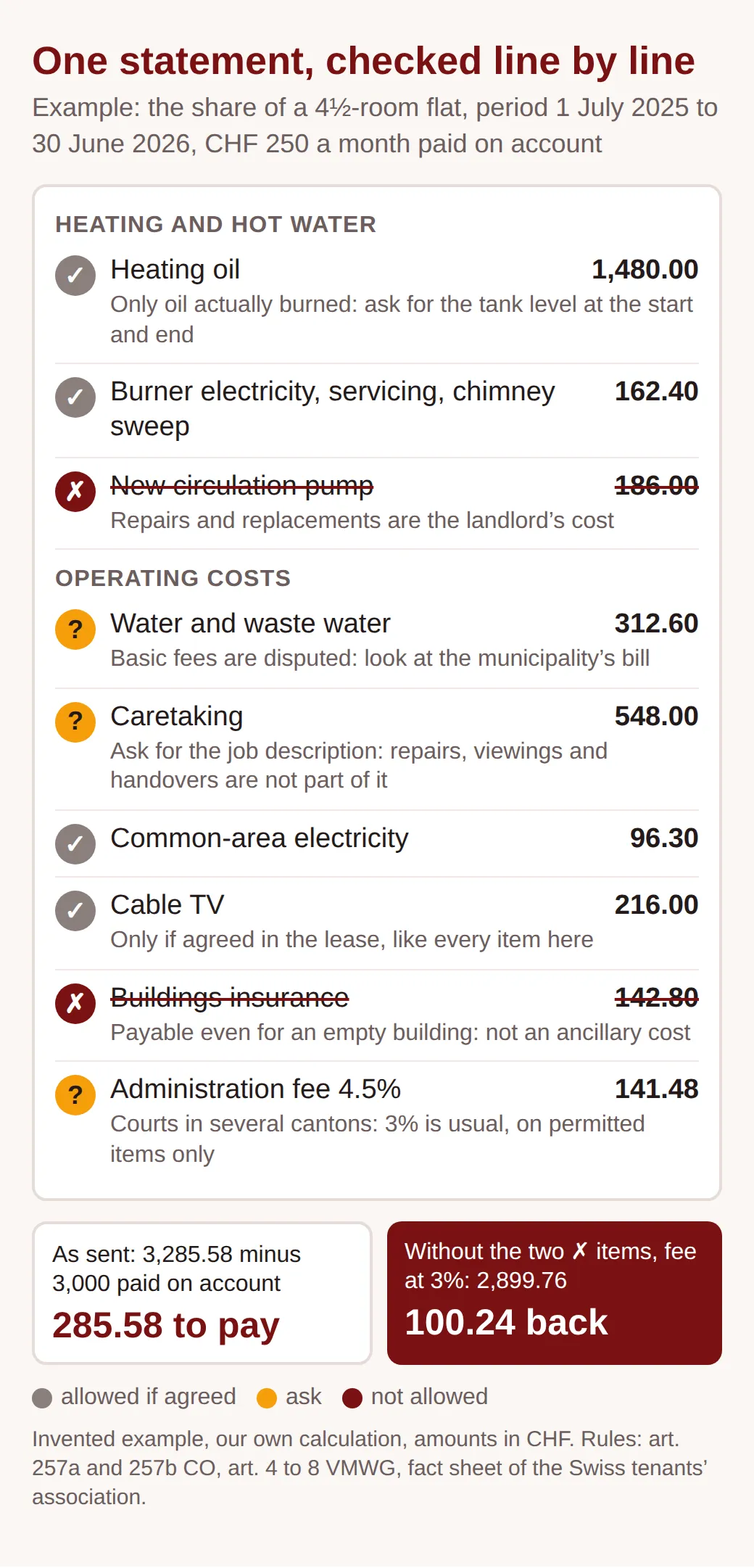
That is why these costs never belong in the statement, even if they are listed in the lease: repairs and replacement of appliances and installations, interest and depreciation on installations, buildings insurance and property tax. In its fact sheet, the conciliation authority in Kreuzlingen (in German) also lists liability insurance and equipment bought for the caretaker, such as a cleaning machine or a lawnmower, along with its repair.
Items that are not allowed most often hide in catch-all entries. The Swiss tenants' association (Mieterinnen- und Mieterverband) has collected the typical cases in its fact sheet on allowed and disallowed ancillary costs (in German). For caretaking, for example, the wages for cleaning, running the heating and small jobs like changing light bulbs may be charged. Handing over flats, showing them to prospective tenants, repairs and coordinating tradespeople are not part of it. For the lift, the electricity is allowed, and in common practice so is a service contract for routine maintenance, but repairs and spare parts are not. If the building's washing machine takes coins or a card, that income has to be deducted from the electricity and water costs.
Some items are disputed, and there it is better to ask than to strike them out. That applies above all to basic fees for water and waste water that do not depend on consumption, and to service contracts for installations such as fire alarms or garage doors. The tenants' association considers basic fees that do not depend on consumption not chargeable. The property management in the Zurich case further down saw it differently, and the two sides agreed on 15 percent off these items. The biggest amount on the statement, though, is usually heating.
Heating costs: where the big amounts are
For heating and hot water, the law sets out exactly which costs may be charged (art. 5 VMWG). They are the fuel and energy consumed, the electricity for burners and pumps, cleaning the system and the chimney, the regular servicing including the oil tank, descaling the boiler and pipes, measuring consumption, maintenance, insurance that covers only the heating, and the administrative work of running it. Repairing and renewing the system, and interest and depreciation on it, may not be charged (art. 6 VMWG).
One word in that list matters most: "consumed". With oil heating, what counts is not the oil bought during the period but the oil that was burned. If the tank was filled up in spring, what is left over belongs to the next year. That is why you are entitled to know how much was in the tank at the start and at the end. If the statement does not come with a detailed breakdown of the heating costs, the bill has to state that you can ask for one (art. 8 VMWG).
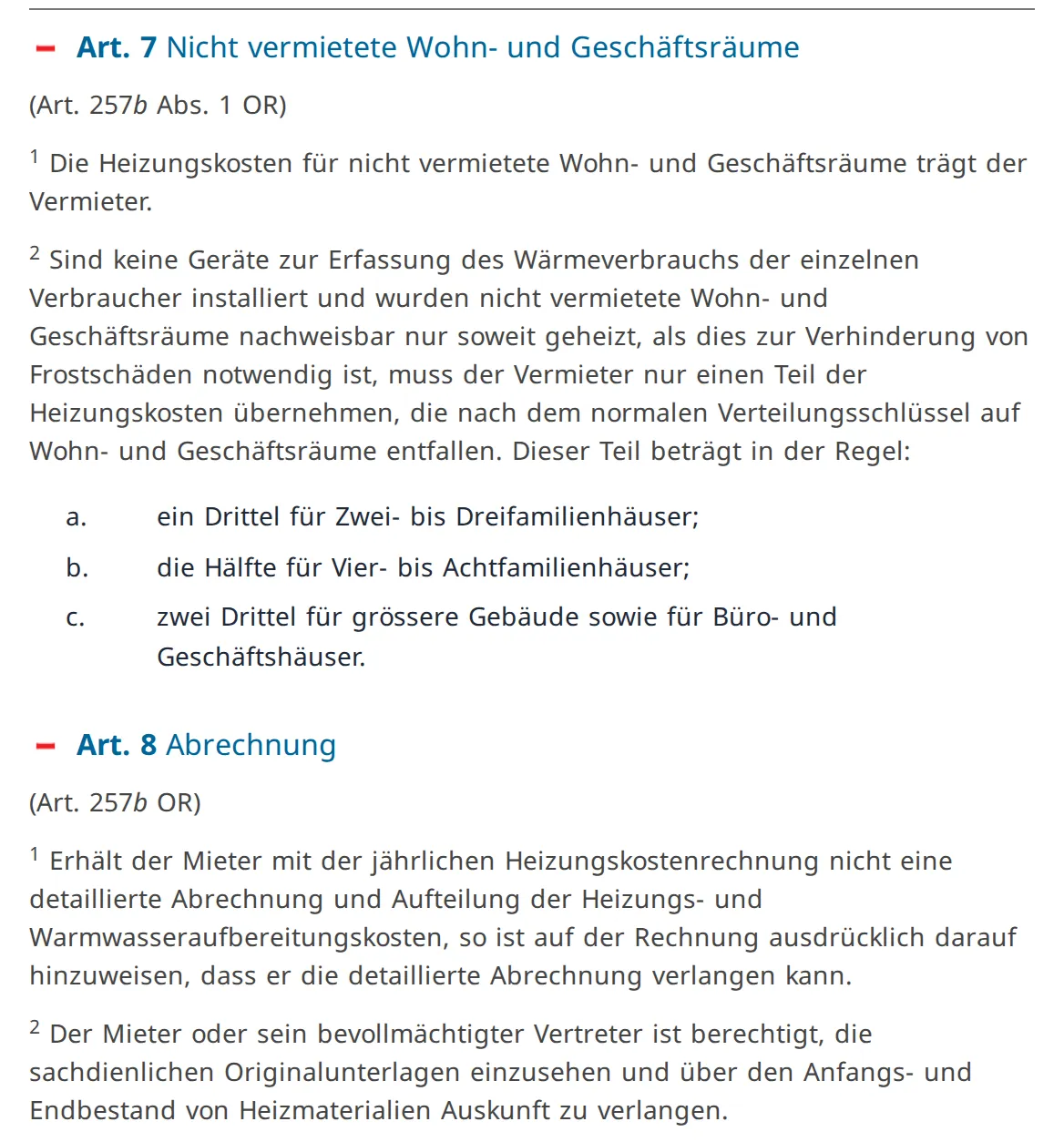
The extract above also contains a rule that hardly any guide mentions: the landlord bears the heating costs for flats and business premises that are not let (art. 7 VMWG). If a flat in the building stood empty for months, its share may not be spread over the other tenants. Only where there are no heat meters and the empty flat was demonstrably heated just enough to prevent frost damage does the landlord pay less: as a rule a third of the share in buildings with two or three flats, half in buildings with four to eight, and two thirds in larger buildings. So ask whether any flats stood empty during the period and how that was accounted for.
How the heating costs are split within the building depends on the building. Splitting them by floor area or by volume is common. For new buildings and major renovations, the cantons require billing by consumption (art. 45 of the Energy Act, current text in German, French and Italian only). According to the tenants' association, you have no general right to your own meters. Check whether your share in the allocation key has stayed the same as last year. If it changed without any building work, that is a reason to ask. Finally, on top of the heating and every other item, the property management adds its fee.
How high can the administration fee be?
For drawing up the statement, your landlord may charge administration costs, either based on the actual work or "within the usual rates" (art. 4 para. 3 VMWG). A fixed percentage of the ancillary costs is widespread. Which rate counts as usual is not set anywhere in the law, and it is disputed.
The Kreuzlingen conciliation authority writes in its fact sheet that 2 to 3 percent may be added for administering the heating costs. The tenants' association says tenants do not have to accept more than 2 to 3 percent. It points to court decisions from Lucerne, Basel and St. Gallen and to a notice from the Federal Office for Housing, according to which 3 percent at most is usual. According to a 2010 report by SRF (in German), the St. Gallen district court found a fee of 4.5 percent too high and said 3 percent was customary in St. Gallen. Practice is not uniform: in 2024 SRF gave three to four percent as the usual rate in most regions. Two points still hold. You do not have to simply accept a rate above 3 percent: if the agency claims it is customary locally, the tenants' association says you can ask for proof. And the fee may only be charged on permitted items: if an item drops out, the fee goes down with it.
A percentage also has a weakness that became visible after the winter of 2022/23. When energy prices rise, the fee rises with them, even though the agency does no more work. SRF described a building where the fee on the 2022/23 statement was 72 percent higher than the year before. In that report, the Zurich tenants' association asked whether this was not a hidden rent increase. If you see a much higher fee after a winter of high prices, ask what extra work is behind the extra amount. Whether the figures behind all these items are right, though, you will only see in the receipts.
How to inspect the receipts
Your landlord has to let you inspect the receipts if you ask (art. 257b para. 2 CO). For heating costs, the ordinance says explicitly that this means the original documents. You may take someone with you or send someone with your authority, for example an adviser from the tenants' association.
The inspection usually takes place at the offices of the landlord or the property management, during normal business hours. The agency does not have to send you free copies, according to HEV Zürich. You may take photos or copies of the receipts yourself at your own cost, according to the guide by the insurer Mobiliar (in German). Ask for an appointment in writing. If your landlord or agency writes to you in German, French or Italian, it makes sense to reply in that language. A short version could read:
Ancillary costs statement 2025/26, flat at [address]
Dear Sir or Madam
Under art. 257b para. 2 CO and art. 8 VMWG, I ask to inspect the receipts for the statement dated [date], including the heating oil stock at the start and end of the period, the allocation key and the caretaker's job description. Please suggest an appointment within 30 days. Until this is cleared up, I will pay the undisputed part of the statement.
Kind regards
Once you are there, it pays to look for specific things rather than read every bill. Are the invoice dates within the billing period? Does a tradesman's invoice say "Ersatz" (replacement), "Reparatur" (repair) or "Neu" (new)? Is the oil stock right? Do all the shares in the allocation key add up to the same total as last year, or has a flat or a shop disappeared? And what exactly does the caretaker do according to the job description, and how many hours are charged for it? The Zurich case shows what can come out of it.
What a check can achieve
On the housing estate whose 2022/23 statement the Zurich tenants' association examined (in German), clear errors came to light first. A commercial unit had been taken out of the allocation key because of a contractual arrangement, so its share fell on everyone else. The electricity for the heating had been deducted in the wrong place, and an item for commercial waste was removed from the statement. On top of that, reserves for the boiler and the tank were released because of a planned building project and credited to the tenants. Corrections and reserves together lowered total costs by about 2 percent.
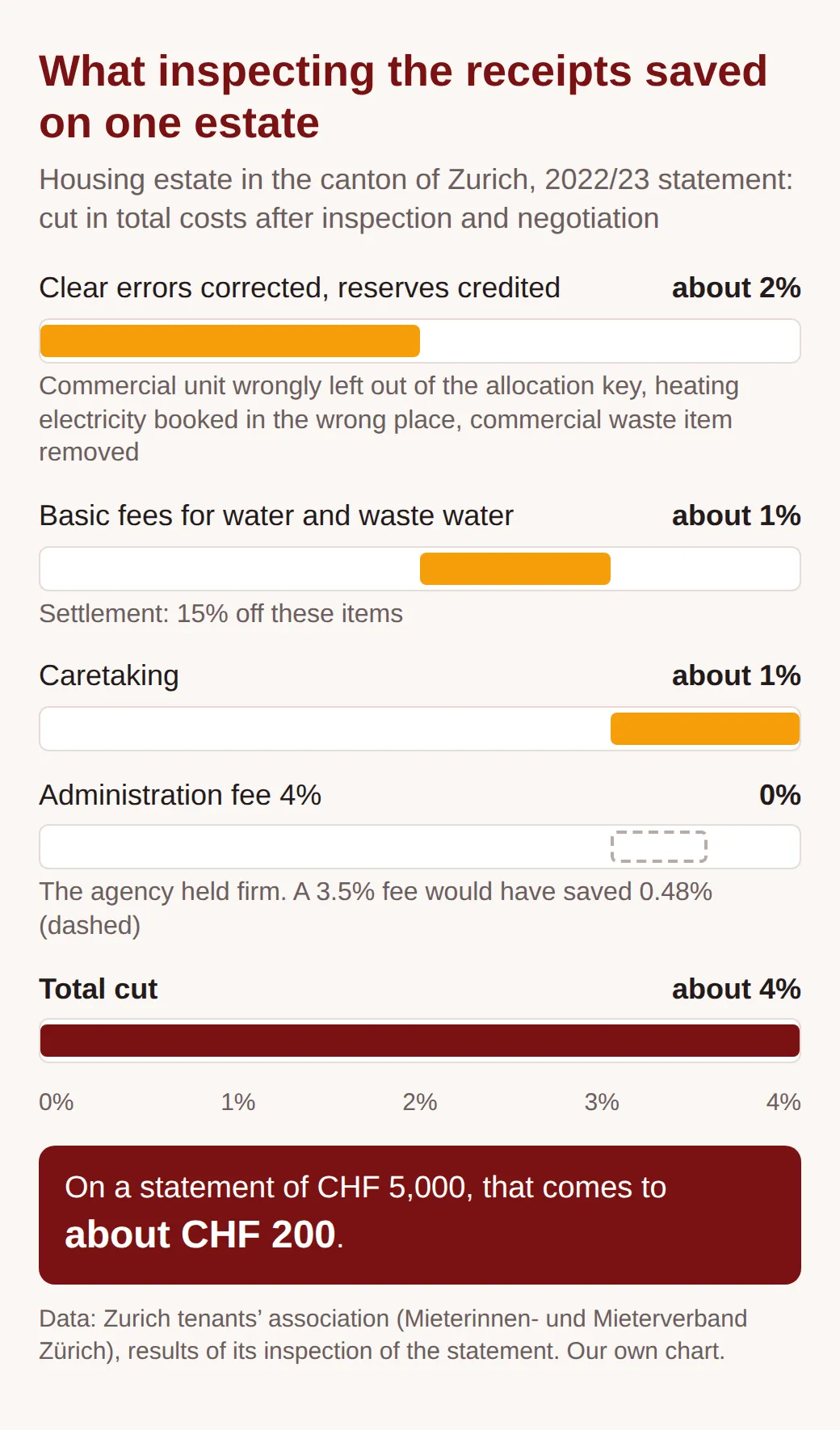
The disputed items were negotiated. For the basic fees for water and waste water, the association asked for 20 percent less. The property management offered a settlement of 15 percent, expressly for that period only, which lowered total costs by about 1 percent. Caretaking brought another percent. On the fee of 4 percent the agency held firm, pointing out that it had been agreed in the lease. A rate of 3.5 percent would have made up 0.48 percent of total costs. The association also records where the tenants got nowhere: on caretaking, they would have had to prove that less work was done.
There are two lessons here. One error was in the allocation key, and many tenants had already noticed on their statement that their share differed from the year before. So comparing with last year's statement is always worth it. And a check pays off most when tenants do it together: when several households in a building get the same statement, they all benefit from the same inspection. By the time the questions are answered, though, there is usually a payment deadline looming.
Pay, withhold or pay under protest?
Pay the part you do not dispute and withhold only the disputed rest. That is what the Kreuzlingen conciliation authority recommends. Its principle: whoever wants money from the other side has to take action. If your landlord refuses to let you inspect the receipts, it is up to them to take their claim to the conciliation authority.
Withholding money is not entirely without risk. If you are behind with ancillary costs, your landlord can set you a deadline of at least 30 days in writing and warn you that the lease will be terminated. If you do not pay, they may terminate with at least 30 days' notice to the end of a month (art. 257d CO). HEV Zürich writes in its answers for owners (in German) that such a termination only succeeds if the statement was legally correct. You should not put that to the test, though. If you receive a deadline like this, pay the amount demanded and tell your landlord by registered post that you are paying while reserving the right to claim it back. That is the advice in the Mobiliar guide.
There is no statutory deadline by which you have to raise objections. Some leases say 30 days, but according to the Mobiliar guide that is not a legal deadline, and you can still challenge a statement later. Conversely, the same guide writes that under the prevailing legal opinion, a landlord's claims for extra payments expire five years after the end of the billing period. So if a statement arrives very late, check that too. If you have already paid, the question is a different one: how do you get the money back?
Overpaid: how far back can you claim?
Your landlord has to pay back the credit from a correct statement, and that part is simple. It gets harder with items you paid even though you did not owe them, for example because they were never agreed. Then it is a question of what the law calls unjust enrichment, and that has its own rules, as the Federal Supreme Court confirmed in the 2018 case.
You can claim the money back if, when you paid, you believed you owed it (art. 63 CO). That mistake does not have to be excusable. If you could have known but did not, it does not count against you. In the case before the Federal Supreme Court, it was enough that the couple believed they owed the money until the tenants' association told them otherwise. That leads to a practical rule: if you know an item is not owed and pay it anyway of your own free will, you cannot claim it back under this article. So never pay a disputed item without comment, only with a written reservation of your right to claim it back, as described above.
The claim expires three years after you learn of it, and at the latest ten years after the payment (art. 67 CO). So if you realise that for years you have been paying for an item that was never agreed, you can claim up to ten years back, but you have to act within three years.
If you cannot reach an agreement with your landlord, turn to the conciliation authority for tenancy matters where the flat is. The Federal Office for Housing links to the addresses of the conciliation authorities (in German). In disputes over the rental of flats, conciliation proceedings are free of court costs (art. 113 of the Civil Procedure Code).
What to do now
Put the statement next to your lease and mark every item that is not named there. Then mark everything that looks like a repair, a replacement, buildings insurance or a tax, and note the rate of the administration fee. For the heating costs, ask about the oil stock and any empty flats.
If you have questions, ask in writing to inspect the receipts and pay the undisputed part until then. Talk to your neighbours, because their statements share out the same costs. And while you have your lease out anyway, check which reference interest rate your rent is based on. Our article on it shows whether you are entitled to a rent reduction.
Common questions
Can my landlord increase my monthly payments on account for ancillary costs?
Yes, but not at will. If you agree to an increase, a written agreement is enough. Without your consent, your landlord needs the official form for changes to the lease, sent at least ten days before the notice period begins and taking effect on the next termination date. You can challenge such a change at the conciliation authority within 30 days.
Why does my neighbour pay less for a flat the same size?
There can be several reasons. In buildings with heat meters, part of the heating costs depends on each flat's own consumption. And not every lease in the building has to list the same ancillary costs: older leases often have fewer items. So compare the two leases first, then the allocation keys.
Can I opt out of cable TV to stop paying for it in my ancillary costs?
According to the Swiss tenants' association, yes, if you take action. You have to cancel the connection for your flat, or say when you move in that you do not want to use it. After that, the cost may only be charged for flats that have a subscription.
Does my landlord have to send me copies of the receipts?
No. The law gives you a right to inspect the receipts, not to have copies posted to you. The inspection usually takes place at the offices of the landlord or the property management, during normal business hours. You may take photos or copies there, at your own cost if the agency charges for them.
Is there anything to check if I pay a flat fee for ancillary costs?
Less, but not nothing. A flat fee has to be based on the average of three years, and it may only cover items that are in your lease and are genuine ancillary costs. What you do not get with a flat fee is an annual statement with a balance to pay or a refund.
More from the blog
All posts
Minimum temperature in a Swiss rented flat: your rights
No legal minimum temperature, just reference values: 20 °C living room, 17 bedroom, 23 bathroom. What they mean for tenants and what to do if it stays cold.

Flat handover in Switzerland: defects list, deadline, photos
Moving into a rented flat in Switzerland: what goes in the move-in report, when to send your defects list and which photos save you money at move-out.

How to challenge a landlord's notice in Switzerland
Notice from your landlord? You have 30 days from the collection slip. Void without the official form, set aside if abusive, extensions of up to four years.