Minimum temperature in a Swiss rented flat: your rights
The short answer
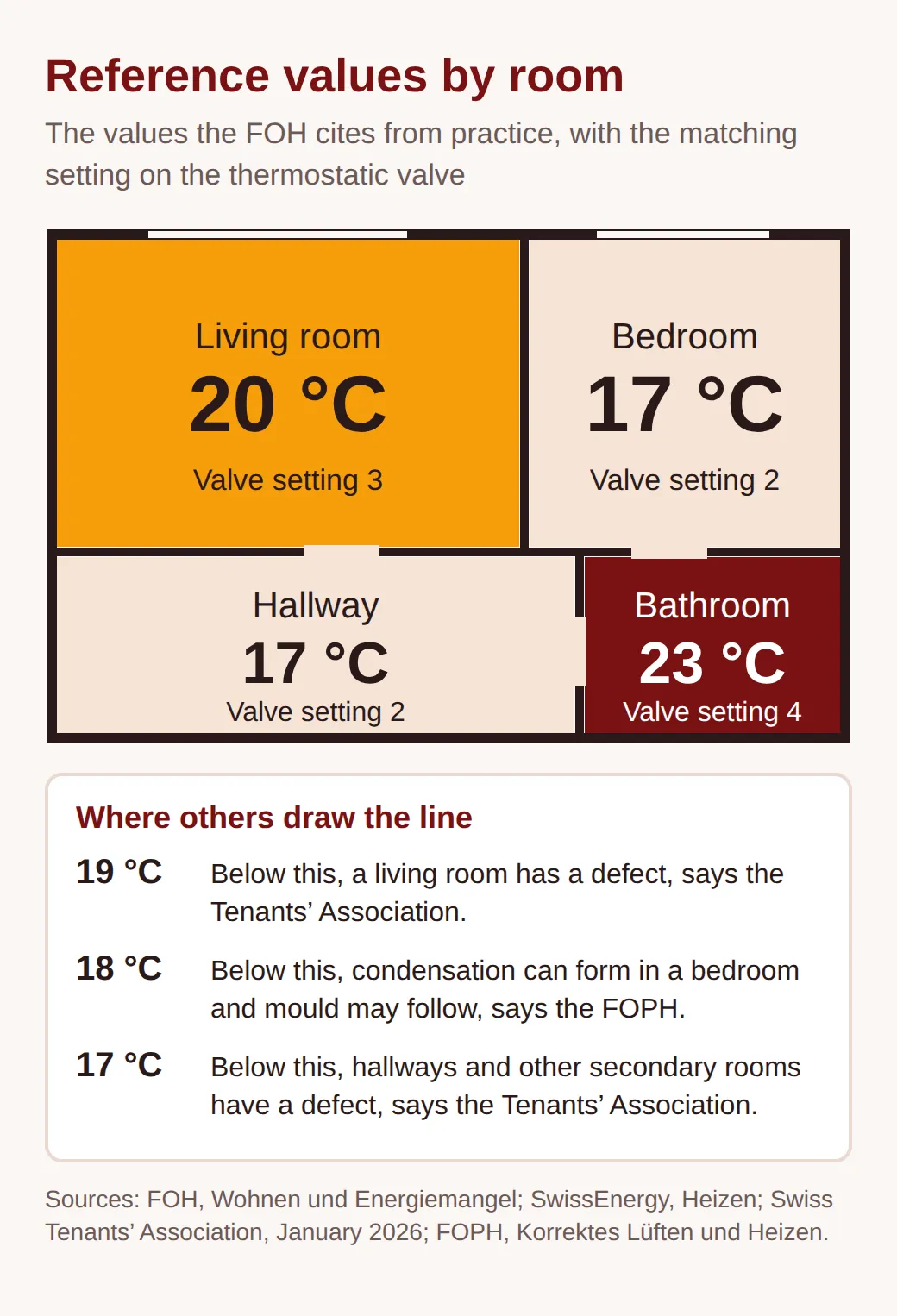
Switzerland has no legal minimum temperature for rented flats. The Federal Office for Housing (FOH) does name reference values from practice, though: 20 °C in living areas, 17 °C in bedrooms and hallways, 23 °C in the bathroom. If your flat stays well below that even with the heating on, it will usually have a defect. You can then ask for it to be fixed and for a lower rent.
What makes these three figures interesting is where they come from. They are not in any law. They come from an energy-saving tip about radiator thermostats. That explains why 17 °C is supposed to be enough in a bedroom, while the Federal Office of Public Health warns of mould there below 18 °C. And if you search online for a minimum temperature, you often end up on German websites built on German tenancy law, which does not apply here. We show what the Swiss figures actually mean for you, when the heating has to be on, what one degree costs and what to do if your flat stays cold.
Where the 20 °C comes from
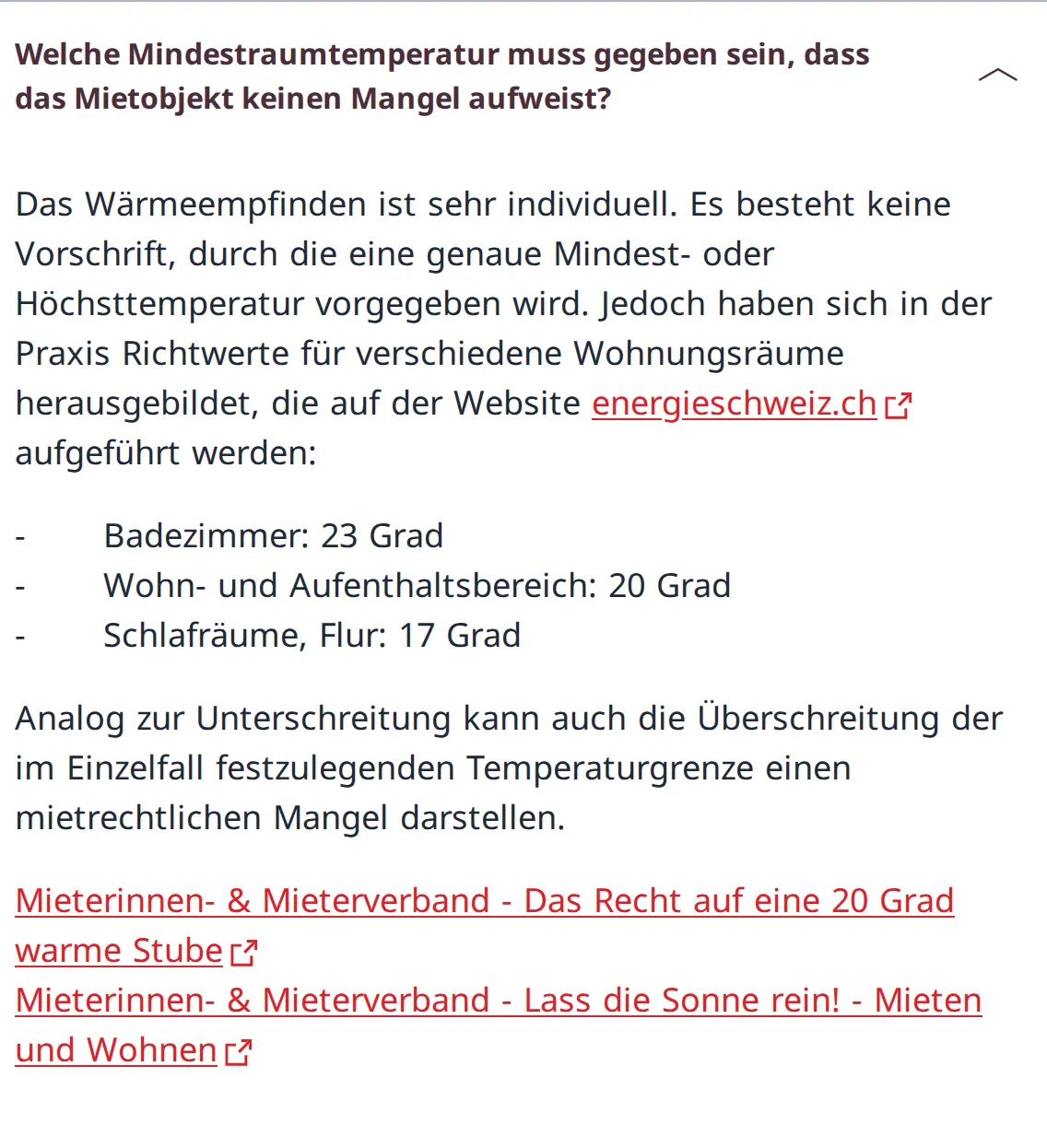
The reference values started out as energy-saving advice, which tenancy law then adopted as a yardstick. On its page on housing and energy shortages (in German), the FOH answers the question about a minimum temperature like this: there is no rule that sets an exact minimum or maximum temperature. In practice, however, reference values have emerged, and for these the office refers to SwissEnergy, the federal government's energy-saving programme.
SwissEnergy (in German) gives the same figures in its advice on setting radiators correctly. There they are called "usual average values" and are linked to the settings on the thermostatic valve: setting 4 for 23 °C in the bathroom, setting 3 for 20 °C in living areas, setting 2 for 17 °C in bedrooms and hallways. Just below comes the sentence that puts the numbers in context: there is no correct room temperature, and comfort is a personal matter.
So the reference values are not a hard threshold that triggers anything automatically. They are a yardstick for what should be achievable in a normal flat. How a court or a conciliation authority treats them is the next question.
What the reference values mean under tenancy law
A flat that cannot be heated to a normal temperature has a defect. The basis is Art. 256 CO: the landlord must hand over the flat in a condition fit for its intended use and keep it that way. For flats, the lease cannot depart from this to your disadvantage; such a clause would be void.
The FOH puts it cautiously: if the reference values are clearly not reached, there may be a defect, and for as long as it lasts you are in principle entitled to a rent reduction. How large it is depends on the case and, in a dispute, is up to the court. According to the FOH, reductions of 10 to 20 percent have been granted in individual cases where the temperature was a few degrees too low.
Even the Swiss Tenants' Association (in German) does not give one single figure for where "clearly" begins. In its article of January 2026, it draws the line at 19 °C for living rooms and 17 °C for hallways and other secondary rooms. In its factsheet on cold flats (in German), on the other hand, it says that 20 to 21 °C during the day is the standard today. In practice, this means: going by the 2026 article, one degree below the reference value in the living room is not yet a defect. If the temperature stays a few degrees below it for weeks, though, there is a strong case for a defect.
The list of rulings kept by the Zurich courts (in German) shows what this looks like in a real case. In a flat in Geneva, the room temperature was between 16 and 20 °C from October to May for three years. In December 2000, the Geneva Cour de justice granted a reduction of 20 percent. That fits the Tenants' Association's factsheet, which considers about 20 percent appropriate at 16 to 18 °C.
Is 17 °C too cold for a bedroom?
For sleeping, perhaps not. For the walls, often yes. The Federal Office of Public Health (FOPH) (in German) counts bedrooms among the problem rooms where damp and mould damage are common. Low temperatures do make for more comfortable sleep. But below 18 °C, or with only slightly lowered temperatures in poorly insulated buildings, condensation can form on cool walls and window frames, especially if the bedroom door is open.
The FOPH gets more specific in its brochure on mould in the home (in German). In well insulated and ventilated buildings, it says, turning the bedroom down to 18 °C is not a problem. In older, poorly insulated buildings from the 1960s and 1970s, you should not put off turning the heating on, and should keep rooms at about 20 °C.
So 17 °C is an energy-saving figure, not a health figure. The Tenants' Association gives no separate value for bedrooms: its 17 °C applies to hallways and other secondary rooms. If your bedroom stays at 16 °C with the valve turned all the way up and the windows are misted over in the morning, you have two problems that belong together. Report both to your landlord. Before it comes down to degrees, though, there is often a simpler question: is the heating even on yet?
When the heating has to be on
The Code of Obligations sets no fixed date for the start of the heating season. The landlord's duty depends on the state of the flat, not on the calendar (Art. 256 CO). If your lease or its general terms name a heating season, that is a guide. But it does not change the fact that the flat has to be fit to live in.
The canton of Vaud gives an insight into how tenants and landlords settle this between themselves. Since 1 July 2026, a new framework lease has applied there to every tenancy in the canton, the Règles et usages locatifs (RULV). The cantonal government declared it generally binding (in French), and the Federal Council approved this in June 2026 (in German). It is currently the only generally binding framework lease in Switzerland. It sets no date for the heating. Article 30, paragraph 6 says: "Le propriétaire décide de la mise en service ou hors service du chauffage en tenant compte des désirs exprimés par les majorités des locataires." In other words, the owner decides when the heating is switched on and off, taking into account the wishes of the majority of tenants in the building.
That is a useful pointer for every canton. If it turns cold early in the autumn, a joint letter from several households to the property management carries more weight than a single phone call. And in poorly insulated buildings the FOPH expressly favours turning the heating on early, because cold walls encourage mould. Heating earlier does come at a price, though, and it can be calculated fairly precisely.
What one degree more costs
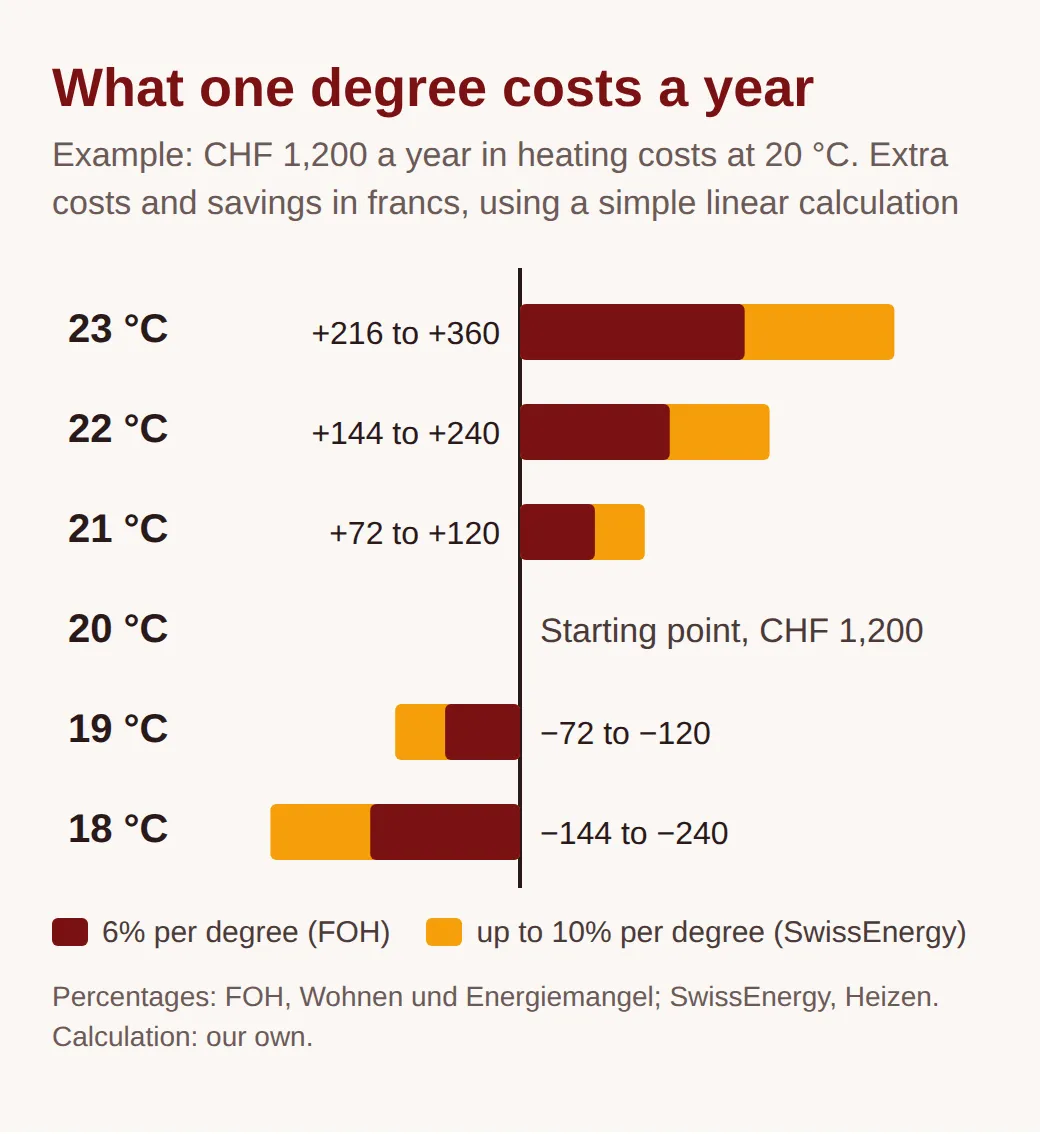
Every extra degree of room temperature raises heating costs by about 6 percent, says the FOH. SwissEnergy puts it at 6 to 10 percent. Take heating costs of CHF 1,200 a year as an example: 22 °C instead of 20 °C then costs about CHF 144 to 240 more. The other way round, 19 °C instead of 20 °C saves about CHF 72 to 120.
Whether you feel this in your own wallet depends on how your building bills heating. If heating costs are split by a fixed formula, such as floor area, everyone pays together for the warm living room on the third floor, and your savings benefit your neighbours as much as you. With consumption-based billing of energy and water costs, known in German as VEWA, saving pays off especially well, according to the FOH. How to check the heating costs on your statement is explained in our post on the ancillary costs statement.
Being away a lot does not automatically save you money. Article 30 of the Vaud framework lease states that tenants bear their heating and hot water costs in full, even during a long absence. That raises the question of what your own part is in keeping the flat warm and dry.
Your duties: heat, air, report
As a tenant, you also have duties when it comes to temperature. The law puts it briefly: you must use the flat with due care (Art. 257f CO). The Vaud framework lease is more explicit and requires in Article 9 that you "aérer et chauffer de manière appropriée et régulière", that is, air and heat the rooms appropriately and regularly. It also requires you to prevent frost damage while you are away, and makes you answer for damage you cause yourself.
On airing, the FOPH is surprisingly specific. Its recommendations for flats that are aired through the windows:
- Air the whole flat with a through draught in the morning, at midday and before going to bed, with all windows wide open.
- During the heating season, air for at least 5 minutes; on very cold or windy days, and when cross-ventilating, 3 minutes are enough.
- No windows left open or tilted all the time in winter: they waste a lot of energy and cool down the walls.
- Keep humidity between 30 and 50 percent during the heating season, and not above 40 percent on very cold days.
- Place large furniture about 10 centimetres away from outside walls.
If mould appears anyway, you have to report it. Defects you do not have to fix yourself must be reported to the landlord, or you are liable for the damage that results (Art. 257g CO). The FOPH brochure advises describing or photographing the damage and sending the report by registered post. Finding the cause is then up to the landlord. And mould does not automatically mean you aired the flat wrongly: in a 4½-room flat in Arlesheim, mould formed in the corner of a room. No fault on the tenants' part was proven, and in 1999 the High Court of Basel-Landschaft granted a reduction of 10 percent. If you have done your part and the flat still stays cold, the ball is in the landlord's court.
If your flat stays cold: what to do
Start with evidence, because without measurements a dispute comes down to your word against theirs. Buy a simple thermometer and measure over several days, morning and evening, with the valves fully open. Put it in the middle of the room, not next to the radiator or in the sun. That is our advice; there is no official rule on how to measure. The Tenants' Association recommends noting the date, time and temperature, photographing the thermometer reading and the radiator, and asking your neighbours.
Report the defect straight away. If the heating fails completely, the Tenants' Association advises calling and then sending an email straight after, setting a short deadline of 2 to 3 days, so that your report is on record. If nothing happens, the FOH recommends a registered letter stating the temperatures you measured. In short, it can read like this:
Insufficient room temperature in the flat at [address], [floor]
Dear Sir or Madam
Since [date], my flat has only reached the following temperatures, even with the radiator valves fully open: living room [x] °C, bedroom [x] °C (measured on [dates], list enclosed). Please have the heating repaired by [date]. For as long as the defect lasts, I claim an appropriate reduction of the net rent from my first report on [date].
Yours faithfully
If the deadline passes and nothing happens, you may have a defect that makes the flat less usable, but not unfit to live in, repaired at the landlord's expense (Art. 259b CO). Announce this by registered letter. The Tenants' Association warns, however, that expensive work such as replacing a heating burner goes too far. In an emergency, for instance if the heating fails on a Friday evening and neither the property management nor the caretaker can be reached, the Tenants' Association says you may call the emergency repair service directly and rely on the rules on agency without authority (Art. 422 CO). If possible, use the company whose number is on the boiler, and only have the bare minimum done. Keep every receipt, including for an electric heater.
The rent reduction itself runs from the day the landlord learns of the defect. What percentages are realistic, why you should never simply cut the rent yourself and how depositing the rent with a cantonal office works are explained in detail in our post on defects and rent reductions. The FOH expressly mentions depositing the rent for a flat that is too cold as well, but only with a deadline and a prior warning (Art. 259g CO).
Before the cold weeks begin
Put one thermometer in the living room and one in the bedroom while it is still mild outside. Then, when the first cold snap comes, you know what your heating can do, and you have figures to compare if it comes to a dispute. Check your lease to see whether it names a heating season and how heating costs are split.
If you measure less than 19 °C in the living room over several days, or the bedroom stays below 17 °C, write to the property management before the cold settles into the walls. At the same time, get into the habit of airing briefly three times a day. It costs little heat and is your best argument if there is ever a dispute over mould.
Common questions
Can a rented flat be too hot?
Yes, that can be a defect too. The Federal Office for Housing writes that going above the temperature limit, which has to be set case by case, can be a defect under tenancy law, just like falling below it. There is no fixed upper limit, just as there is no lower one. One example would be heating that cannot be turned down.
Can I turn the heating off completely when I go on holiday?
Turn it down, yes, but better not off altogether. SwissEnergy recommends lowering the temperature in every room while you are away. In the canton of Vaud, however, the framework lease expressly requires you to prevent frost damage while you are away, and if you heat your flat yourself, you must keep a minimum temperature against frost at all times. In poorly insulated buildings the FOPH advises keeping temperatures on the higher side anyway, so that mould does not form.
Who pays for an electric heater if the heating breaks down?
You may be able to claim a stopgap such as an electric heater from your landlord as damages, according to the Swiss Tenants' Association. To do so, keep all receipts. Report the breakdown first, and only buy the heater if no quick repair is in sight.
Is mould in my bedroom my fault for not heating enough?
Not automatically. The cause has to be found, and according to the FOPH that is the landlord's job. Often it comes down to cold walls, ventilation or the building itself. In a case from Arlesheim in Basel-Landschaft, the tenants got a 10 percent rent reduction; no fault on their part was proven. Report mould in writing straight away, or you will be liable for any further damage.
More from the blog
All posts
Flat handover in Switzerland: defects list, deadline, photos
Moving into a rented flat in Switzerland: what goes in the move-in report, when to send your defects list and which photos save you money at move-out.

How to challenge a landlord's notice in Switzerland
Notice from your landlord? You have 30 days from the collection slip. Void without the official form, set aside if abusive, extensions of up to four years.
Subletting in Switzerland 2026: consent, rent and Airbnb
Subletting in Switzerland: when your landlord can say no, what you may charge for a room, the rules for Airbnb and who is liable. With real court cases.