Flat handover in Switzerland: defects list, deadline, photos
Ten days that count
At the flat handover, have every defect written into the move-in report, even the smallest. Send anything you miss on the day within about ten days, as a list of defects with photos by registered letter. No law sets that deadline, but the longer you wait, the weaker your evidence. When you move out, this list is compared with the move-out report.
A ruling by the Zurich rent tribunal of 8 June 2026 (in German) shows how much can hinge on what is on paper. In 2018 a tenant had moved into a 3½-room flat with a signed handover report, a list of defects and photos. After he moved out in 2023, the landlords billed him CHF 30,187.10 for damage and later sued for about CHF 24,100. The tribunal dismissed the claim in full: their move-out report did not say clearly which defects the tenant was meant to be liable for, their later emails came too late, and repair quotes alone did not prove any damage. The landlords bear the court costs of CHF 3,480 and owe the tenant CHF 4,700 in compensation. When it was published, the ruling was not yet final. Here is how to record the handover so that you are not left empty-handed when you move out years later.
What the landlord owes you
The landlord has to hand over the flat on the agreed date in a condition fit to live in (Art. 256 CO). The law does not require a move-in report, though. It is standard practice because it gives both sides evidence. In the canton of Vaud it is compulsory: the Règles et usages locatifs (in French), which in their version in force since 1 July 2026 apply to every lease in the canton, require a report signed by both sides when you move in.
What matters is what counts as a defect at move-in. During the tenancy you pay for small repairs yourself, such as a new shower hose or a baking tray (Art. 259 CO). At the handover that rule does not apply. The landlord has to sort out even such small things if they are missing or broken when you move in (Art. 258 para. 3 CO). The Swiss tenants' association (Mieterinnen- und Mieterverband; site in German) heads this point "Now or never" in its fact sheet on moving into a flat with defects: whatever you do not ask for at move-in or shortly after, you may end up paying for yourself later. That includes leaking shower hoses, missing soap dishes, dishwasher baskets and baking trays.
For purely cosmetic flaws you have fewer rights. Unless the landlord promised otherwise, they owe you the flat in the condition it was in when you signed the lease. Stained wallpaper or dull, worn floor tiles are then usually something you have to accept, as long as they do not affect day-to-day living. It is different if the landlord has neglected upkeep. The tenants' association gives the example of a stained wall last painted twelve years ago: with a lifespan of eight years for paintwork, a new coat is overdue and you can ask for it. If you want freshly painted walls, get that promised in writing before you sign. The flat does have to be clean when you move in, though. If it is not, complain in writing first and only then clean it yourself. The tenants' association considers CHF 30 an hour a fair rate, which you can bill to the landlord.
Before the appointment: ask for the previous tenant's report
You have the right to see your previous tenant's move-out report at the handover, if there is one (Art. 256a CO). The landlord has to show it to you if you ask. For moving in, it is one of the most useful rights you have.
The move-out report shows what was already broken when the previous tenant left and what they had to pay for. If it lists a burn hole in the carpet or a cracked washbasin, you have written proof that the damage happened before your time. You can also see which repairs were planned and check whether they were done. In the canton of Vaud you can even get a copy on request, not just a look.
Ask for it when you arrange the appointment, so the document is ready on the day. The same article gives you a second right: you can ask how much rent the previous tenant paid. That matters if you think your initial rent is too high, because you only have 30 days from the handover to challenge it (Art. 270 CO).
On the day: how to make the report useful
Take your time, even if the property manager is in a hurry. Go room by room and check floors, walls, ceilings, windows, doors, blinds, kitchen appliances, taps, sockets and switches, and do not just look at them, try them: run the water, switch on the oven and the extractor hood, open and close the windows. The report should also list the number of keys and, if it applies, note that the flat was not clean.
The key is how precise each entry is. "Walls stained" will not help you much at move-out, because nobody will remember which stains were meant. In its fact sheet on moving out (in German), the tenants' association shows what a useful entry looks like: room, wall, position, height, size.
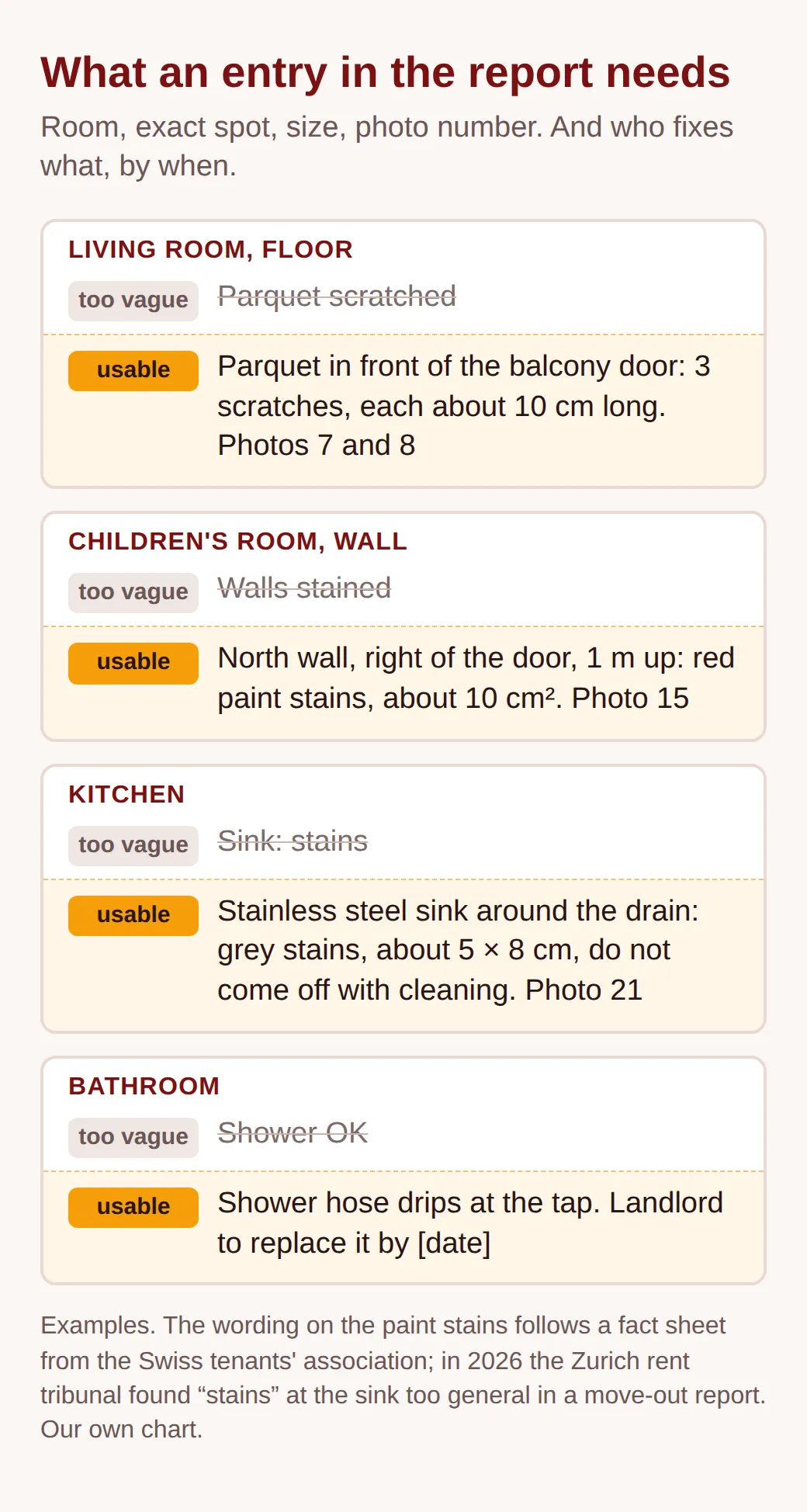
Also note how old the walls and floors are. Ask when the walls were last painted and when the parquet was last sanded or sealed, and have the answer written in. We explain further down why that is worth money when you move out. If a defect turns up that the landlord has to fix, record in the report who will fix it and by when.
Read the whole report before you sign. If something is missing, add it. If you do not have time for a thorough check, write on the report that you will send a list of defects later, and ask for a copy.
Why a vague report can hurt you
A report can work against you. The tenants' association writes in the same move-in fact sheet that where a move-in report exists, defects not listed in it are usually presumed to have arisen after you moved in. Its conclusion: better no move-in report at all than a vague one.
Without a report, the landlord is in a weak position at move-out, because they have to prove that damage happened during your tenancy. With a report full of gaps, they can say: none of this was there when you moved in. Refusing the handover report is still not a good idea, because it also records your rights, such as repairs the landlord has promised. The answer is a precise report plus a list of defects that fills the gaps from handover day.
Reporting defects after moving in: what is the deadline?
The Code of Obligations sets no deadline for a list of defects sent after the handover. In practice every day counts, because the longer you wait, the easier it is for the landlord to argue that the scratch came from your move. Here is what the main sources say:
| Source | Deadline for defects found after the handover |
|---|---|
| Code of Obligations | No fixed deadline |
| Tenants' association fact sheet | Within 10 days of moving in, by registered letter |
| Tenants' association website | In the first 10 to 14 days |
| Canton of Vaud (RULV Art. 1) | As soon as you receive the report, or it counts as accepted |
The Vaud rule is the strictest. It says tenants must report missing defects «dès réception du document et dans les plus brefs délais», on receiving the document and as quickly as possible, or the report counts as accepted. Outside Vaud, check your lease and its general terms. If they set their own deadline, stick to it. If they say nothing, the tenants' association's ten-day rule is a good yardstick.
Send the list by registered letter and keep a copy and the postal receipt. The tenants' association says the best proof is the delivery confirmation you can print from the Swiss Post website. A short letter is enough:
Defects list for the move-in report of [date], flat [address], [floor]
Dear Sir or Madam
Not all defects could be recorded at the handover on [date]. In addition to the report, I am recording the following defects, which already existed when I moved in: [room, spot, type and size of the defect, photo number, one line per defect]. The photos are enclosed.
Please add this list to the report and confirm that you have received it. I would ask you to have the dripping shower hose and [other defects] fixed by [date].
Yours faithfully
Report defects you could not have seen at the handover, such as heating that only runs in winter, as soon as you notice them. You have to do that anyway: if you keep quiet about a defect you are not required to fix yourself, you are liable for the damage that results (Art. 257g CO).
Photos that hold up in court
Photos help, but on their own they are often worthless. The summary the Zurich rent tribunal put at the top of its June 2026 ruling says so plainly: photographs are not enough if it is unclear when and where they were taken. In the proceedings, the tenant had objected that the landlords' pictures were submitted without any context and did not even show his flat. What the landlords lacked at move-out, you can just as easily lack at move-in.
So photograph every defect twice: once from a distance, so the room and the spot can be recognised, and once close up, with something for scale next to it, such as a tape measure or a coin. Number the photos to match your list. The safest timestamp does not come from your camera but from your registered letter: enclose the photos with your list of defects, printed or on a storage device. That establishes that the landlord received them on a specific day.
Keep the original files and do not edit them. A short video walking once through the empty flat is a good addition to the photos, but it does not replace the list. And store everything somewhere you will still find it after you change phones. A tenancy can last ten years.
Why it matters when you move out
When you move out, the landlord has to prove that damage happened during your tenancy. That is what the Zurich courts' page on liability for damage (in German) says, and the rent tribunal's 2026 ruling points out that lawmakers deliberately removed the old presumption that the tenant had received the property in good condition. The landlord's main tool for that proof is comparing the two reports.
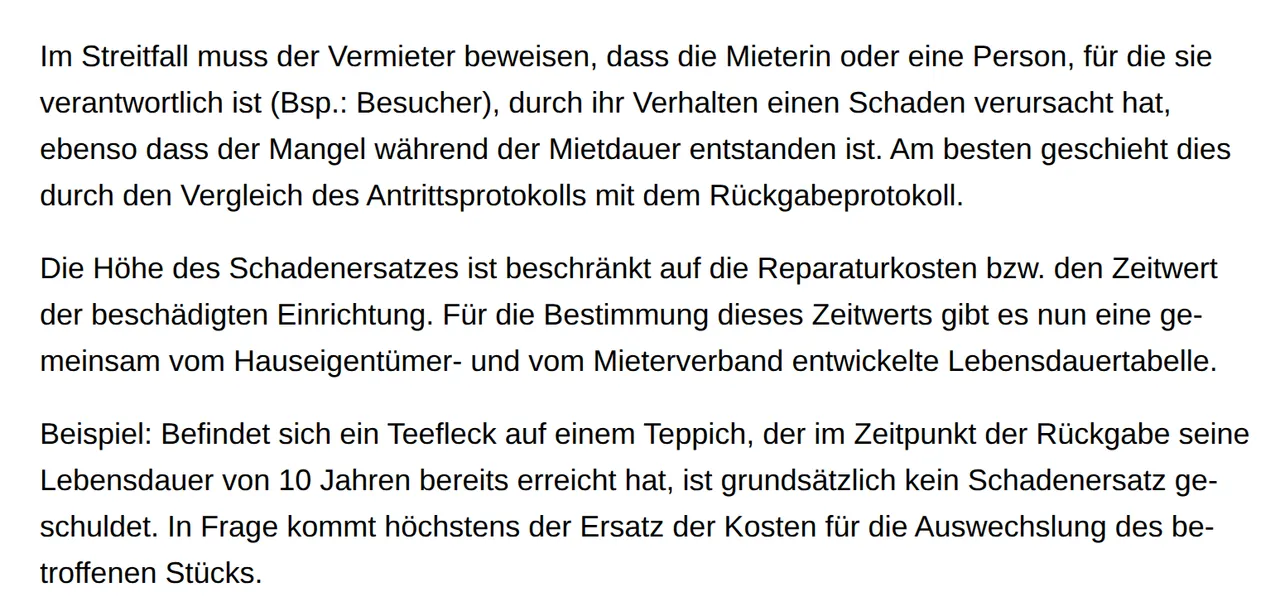
You never pay for normal wear and tear, because that is what your rent covers. Outlines left by pictures, nail holes and faded paint all count as normal. You do pay for excessive wear, but only the current value: the share of the normal lifespan that is left. The homeowners' and tenants' associations have set these lifespans together in the joint lifespan table (in German). The table gives a medium-quality fitted carpet 10 years. For emulsion paint the tenants' association gives 8 years on its page on handing back the flat (in German), and for parquet sealing the joint fact sheet on parquet care (in German) gives 10 years.
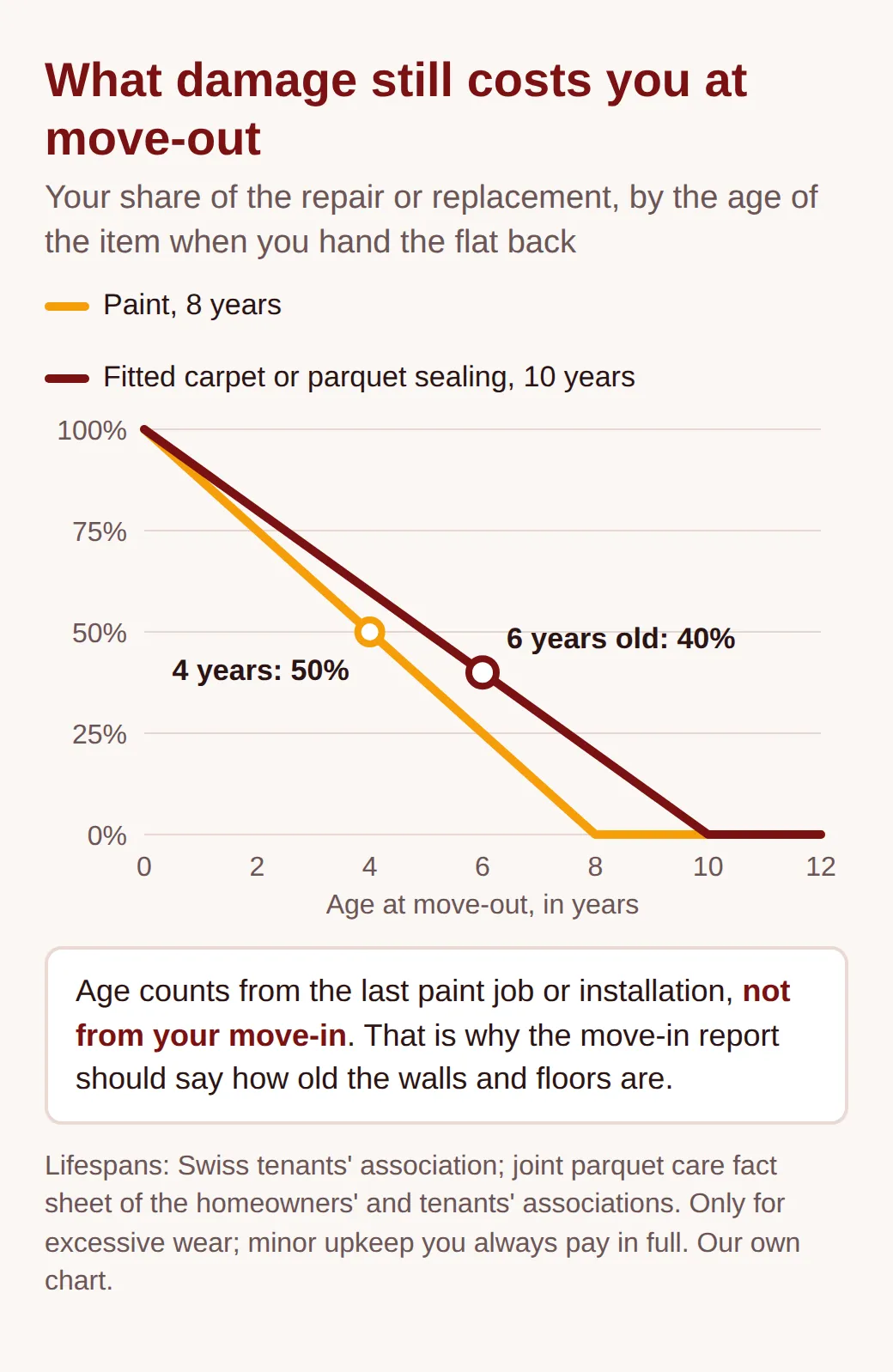
This is where the age you noted at move-in comes in. The tenants' association does the maths like this: a six-year-old fitted carpet with burn marks costs you 40 percent of a new one, and a carpet over ten years old costs you nothing. Age counts from installation or the last paint job, not from when you moved in. If the walls were painted two years before you moved in and you leave after six years, the paint has been written off. If nobody knows when the walls were painted, it is up to the landlord to prove the age in a dispute. If it is in the report, the question is settled.
Two exceptions apply. You always pay in full for minor upkeep, such as a new baking tray, and for extra work such as special treatment against nicotine, even when the paint has reached the end of its lifespan. The landlord has a duty at move-out too. They have to inspect the flat and tell you straight away about any defects they hold you liable for, or they lose their claims (Art. 267a CO). The Zurich rent tribunal generally allows two to three working days. A complaint on the eighth day after the inspection was too late in its view.
When something is wrong at the handover
If the flat cannot be lived in at all on moving day, because the previous tenant is still there or tradespeople are at work, give the landlord a short deadline in writing. The tenants' association suggests one to two days. After that you can withdraw from the lease or insist on the flat, and either way the landlord has to cover your costs, such as a hotel or storing your furniture. You can only withdraw if living there is genuinely impossible or unreasonable (Art. 258 CO). Get advice before you do.
The more common case is smaller: you move in, and the repairs listed in the report never happen. You then have the same rights as for a defect that appears during the tenancy, up to a rent reduction. What percentages courts award and how to apply pressure without putting your home at risk is covered in our post on defects and rent reductions. Your move-in list of defects is the starting point, because it proves from what date the landlord has known about them.
Your plan for the first ten days
Before the appointment, ask to see the previous tenant's move-out report, and ask when the walls were last painted and the floor last treated. On the day, take your time, test every fitting, have every defect entered with its position and size, and only sign once the report is right. Take a copy with you.
Over the first few days, settle in and look closely, in daylight and with furniture against the walls. By the tenth day at the latest, your list of defects goes out by registered letter with numbered photos. Then put your lease, both reports, your list, the postal receipt and the photo files in one folder that you will not need to open again until you move out.
Common questions
Do I have to sign the move-in report?
The Code of Obligations does not require a report at all, so it does not require a signature either. Sign if the content is right, because a report signed by both sides is the strongest evidence either of you has. If something is missing, add it before you sign, or note on the sheet that you will send a list of defects later.
What happens if there is no move-in report?
Then the landlord is missing the most important piece of evidence when you move out. They have to prove that damage happened during your tenancy, and without a report, witnesses or other records that is hard to do. Even so, send your own list with photos by registered letter in the first few days, so that your version is on record with a date.
What if I can't be there for the flat handover?
Send someone you trust with a written power of attorney to check the report and add your comments. In the canton of Vaud, if you do not turn up, the landlord draws up the report alone and sends it to you. You then have to report any missing defects as soon as you receive it, or the report counts as accepted.
Is an email enough, or do I need a registered letter?
The law does not require any particular form. In a dispute, though, you have to prove that your list arrived and when, and that is exactly what the other side likes to deny with emails. The Swiss tenants' association advises confirming urgent notices sent by email with a registered letter.
What if the heating only turns out to be faulty in winter?
That is not too late. Report a defect you could not see at the handover as soon as you notice it. The landlord has to fix it, and from the day they know about it you can ask for a rent reduction. If you wait to report it, you are liable for any damage that results.
More from the blog
All posts
How to challenge a landlord's notice in Switzerland
Notice from your landlord? You have 30 days from the collection slip. Void without the official form, set aside if abusive, extensions of up to four years.

Minimum temperature in a Swiss rented flat: your rights
No legal minimum temperature, just reference values: 20 °C living room, 17 bedroom, 23 bathroom. What they mean for tenants and what to do if it stays cold.

Subletting in Switzerland 2026: consent, rent and Airbnb
Subletting in Switzerland: when your landlord can say no, what you may charge for a room, the rules for Airbnb and who is liable. With real court cases.