Rent reduction for defects in Switzerland: what courts award
First things first
If a defect is not one you have to fix yourself, you can ask your landlord to reduce the rent from the day they learn about it until it is fixed (Art. 259d CO). There is no table of fixed rates. In the list published by the Zurich courts, most cases involving flats fall between 8 and 20 percent. Never simply cut the rent yourself.
A ruling from April 2026 shows how tightly courts calculate. A tenant in a 3½-room flat in Winterthur asked for 15 percent off the rent after water damage. The rent tribunal gave him 8 percent and made him pay part of the court costs. Here is how to classify a defect, which percentages are realistic and how depositing the rent puts pressure on the landlord without putting your home at risk.
Minor, medium, serious: what the category decides
Whether you get a reduction at all depends first on who has to fix the defect. Small defects that can be dealt with by cleaning or minor repairs are the tenant's job, at the tenant's own cost, depending on local custom (Art. 259 CO). Minor defects like these bring no rent reduction. Based on its practice, the conciliation office of Appenzell Ausserrhoden draws the line at costs of roughly CHF 100 per case, in its leaflet on rent reductions (in German). That is a rule of thumb from practice, not a figure from the law.
Anything above that is the landlord's to fix, unless you caused the defect yourself (Art. 259a CO). The law then distinguishes two levels, and the level decides which further rights you have (Art. 259b CO):
| Defect | How you recognise it | What you can ask for |
|---|---|---|
| Minor | Sorted with cleaning or a small repair | Nothing, you fix it yourself |
| Medium | The flat is less usable but still fine to live in | Repair, rent reduction, damages, deposit of rent, having it fixed at the landlord's cost |
| Serious | The flat is badly affected or unusable | Repair, rent reduction, damages, deposit of rent, termination without notice |
The category says nothing yet about the percentage. In 2003 the Federal Supreme Court dealt with a stained carpet full of holes in a building's entrance hall that tenants had complained about for years, and the reduction at stake was 2 percent. Because there was a reduction at all, the carpet did not count as a minor defect in the legal sense, yet it still weighed little. So a medium defect can bring little and a serious one a lot. Just as important is what does not count: the landlord does not have to be at fault. Disturbances the landlord cannot control, such as building work in the neighbourhood or aircraft noise, are also treated as defects by the Zurich courts (in German), and they too can justify a reduction. The aim is simply to restore the balance between what you pay and what you get.
Do not confuse a reduction for defects with a cut based on the reference interest rate. That one is permanent and only takes effect from the next termination date. A reduction for a defect lasts only as long as the defect, but it applies straight away and can be backdated.
When the reduction starts
Your claim starts on the day the landlord learns about the defect and ends when it is fixed. You get nothing for the time before. So every day you wait to report it counts. You have to report defects anyway: if you keep quiet about a defect that is not yours to fix, you are liable for the damage that results (Art. 257g CO).
In a dispute, you have to prove when the landlord knew. A phone call is legally enough but proves little. The Zurich courts therefore recommend a registered letter in which you expressly ask for the repair or for a rent reduction. The Swiss Tenants' Association (in German) advises setting a deadline of about 14 days, shorter in urgent cases, and enclosing photos.
You don't have to name a percentage straight away. According to the Federal Supreme Court, it is enough to have made clear to the landlord that the defect bothers you, for example by asking for the repair (BGE 142 III 557). You can then claim the reduction later, backdated. But once you do claim it, your statement has to say by how much, for what period and which defect it concerns. You can claim back rent you overpaid, and that claim becomes time-barred after five years (BGE 130 III 504). How much to ask for is the harder question.
How much? What court practice shows
The reduction matches the share of value the flat loses because of the defect. Courts compare the value of the flat without the defect with its value with the defect, using objective criteria: what does the lease say, what kind of flat is it, what kind of defect? Whether you are especially sensitive to noise does not count. For medium defects this can hardly be calculated exactly, so courts may estimate from experience and with an eye on earlier rulings (BGE 130 III 504). That is exactly why those earlier rulings are worth a look.
On their page on rent reductions (in German), the Zurich courts keep a list of 19 examples from court rulings as a guide, with a calculator. Twelve of them concern flats. We have charted them together with the Winterthur case:
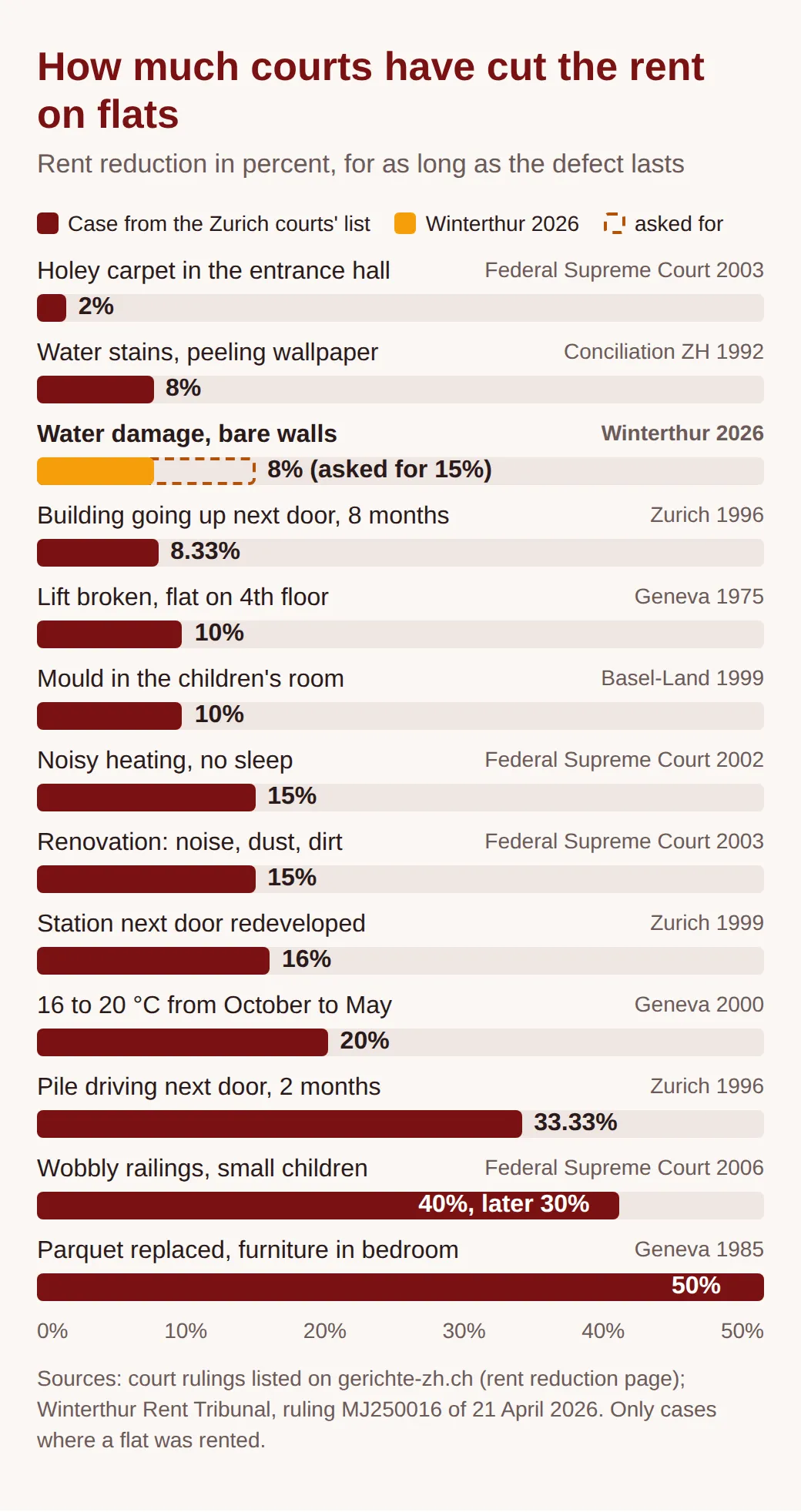
Nine of the thirteen cases fall between 8 and 20 percent: water stains, a broken lift, mould in one room, construction noise, a flat that was too cold. Above that are cases in which part of the flat could no longer be used. In a 2-room flat in Geneva, the parquet had to be replaced after water damage, and the furniture was moved into the bedroom in the meantime. The reduction was 50 percent. In a flat in the canton of Bern, the railings in the stairwell and on the terrace were loose, and the attic room let as a children's playroom could not be heated, with children aged one and three. The reduction was first 40, later 30 percent; the case reached the Federal Supreme Court in 2006.
You learn most from two figures that come from the same ruling. In 1996 the Zurich Rent Tribunal ruled on a 4-room flat with a new building going up next door. For eight months of a crane, diggers and chainsaws, audible even with the windows shut and with the balcony unusable, the tenants got 8.33 percent. For two months of pile driving, in which 17-metre sheet piles were driven into the ground, they got 33.33 percent. Same flat, same ruling: the percentage measures how bad the disturbance is. The duration only decides how many months it applies for.
Two caveats come with this list. The rulings on the Zurich list date from 1975 to 2006, and several come from Geneva. The principles have not changed since, but every court assesses each case afresh. And in the Winterthur ruling, the percentage applied to the net rent, not to the rent including ancillary costs. That is how you should claim it too.
The Winterthur case: 15 percent claimed, 8 granted
The ruling of the Winterthur Rent Tribunal of 21 April 2026 (in German) shows almost everything that matters with defects. On 12 July 2023, during a storm, water pooled on the terrace of a 3½-room flat and ran into the living room and down into the flat below. The walls in the living room, bedroom and study got damp and the plaster bulged. In early 2024 the landlord had the plaster removed, and in March the skirting boards too. From then on the tenant lived with partly bare brickwork.
The landlord argued that the tenant had not cleaned the terrace drain and even claimed CHF 2,775.14 in damages from him. The court saw it differently. It was up to the landlord to prove that the drain had been blocked before the storm, and she could not. An expert report also showed that an emergency overflow was missing and the door threshold was too low. A construction defect like that is the landlord's responsibility, even though, according to her, there had never been damage of this kind before 2023.
On the amount, the court relied on earlier cases: 10 to 15 percent for water damage, 8 percent for water stains and peeling wallpaper. Because the damage had been mainly cosmetic since spring 2024, it set an average of 8 percent of the net rent, from 13 July 2023, when the landlord learned of the damage, until the repair. Purely cosmetic defects can therefore justify a reduction.
The gap is what cost the tenant. The court valued the 8 percent at CHF 4,478.77 and the further 7 percent he had asked for at CHF 3,918.93. Adding the repair, which counted for CHF 10,000, he lost on 21 percent of his claims. So he paid CHF 600 of the CHF 2,900 in court costs, and the compensation for his lawyer was reduced. Before the conciliation authority, asking for too high a rate would normally have cost him nothing, because no court costs are charged there in tenancy disputes (Art. 113 CPC). Before the rent tribunal, it did. The published ruling does not say whether it was appealed.
The lesson: name a rate you can back up with a similar case. And keep paying the full rent while the dispute runs.
Why you should never cut the rent yourself
If you simply deduct the reduction from the rent, you fall into arrears. The conciliation office of Appenzell Ausserrhoden points this out explicitly, and the Swiss Tenants' Association tells tenants never, under any circumstances, to reduce the rent payment on their own. The reason is Art. 257d CO: if you are in arrears, the landlord can give you a written deadline of at least 30 days to pay. If you don't pay, they can terminate the lease with 30 days' notice to the end of a month.
The usual protection hardly helps against this notice. Normally you can challenge a notice given during conciliation proceedings or, in many cases, up to three years afterwards. For a notice given because of rent arrears, that protection expressly does not apply (Art. 271a CO). You would be putting your whole home on the line for 8 or 15 percent.
The Federal Supreme Court does accept that you can offset overpaid rent against future rent. But that only helps if your rate holds up in the end. If it is disputed and a court later sets a lower one, the difference is missing and you are in arrears. If you want to apply pressure without that risk, the law gives you a tool of its own.
Depositing the rent: pressure without risking your lease
When you deposit the rent, you pay it to an official body instead of the landlord, and it still counts as paid (Art. 259g CO). The landlord can then no longer terminate your lease for late payment. The money stays there until it is settled who it belongs to. For the landlord, that is a strong reason to finally get the repair done.
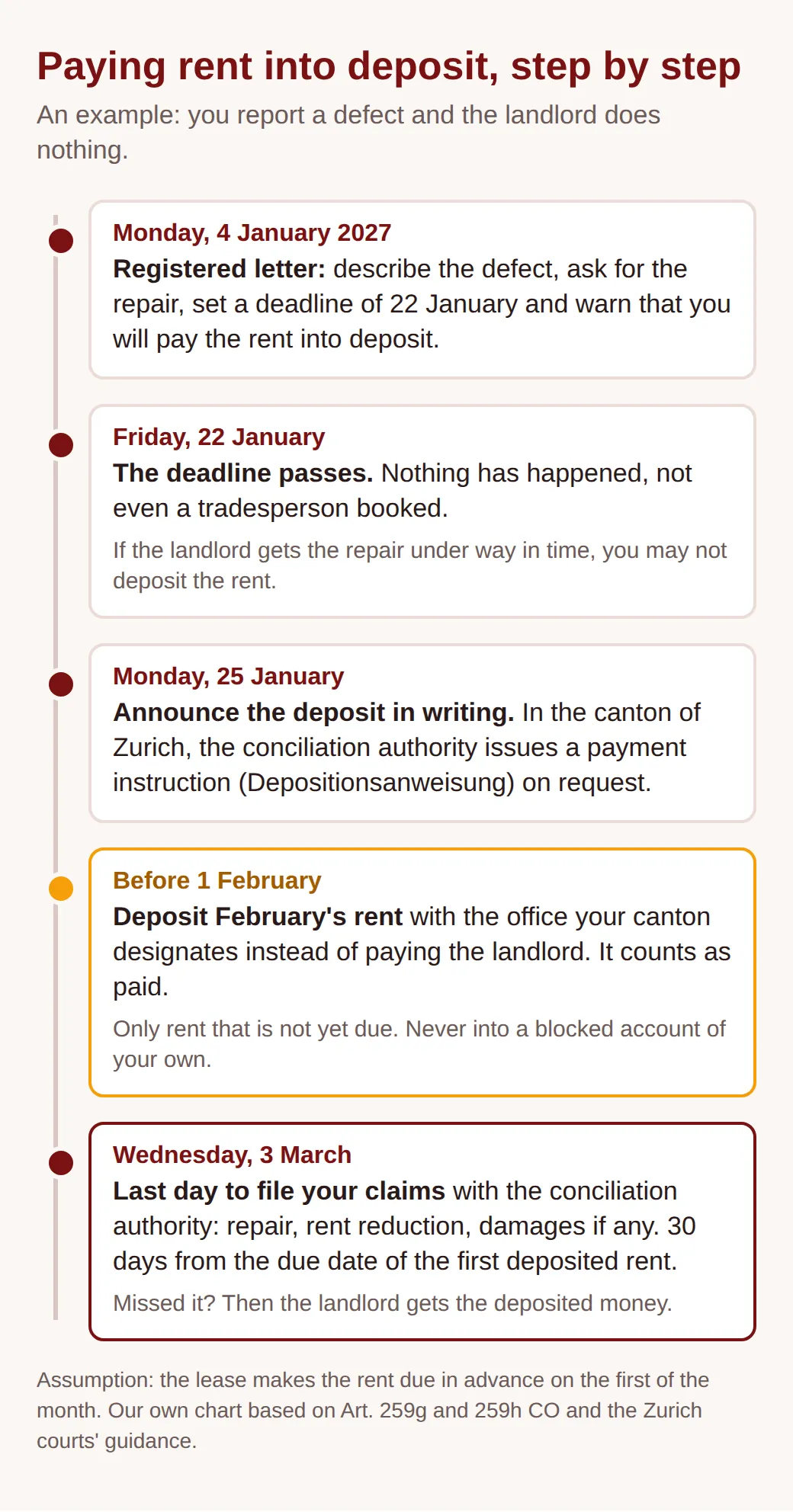
The deposit has strict rules, and if you skip a step you lose its protection:
- You ask in writing for the repair, set a reasonable deadline and warn that you will deposit the rent if nothing happens.
- The deadline passes without the landlord fixing the defect or at least getting the repair under way.
- You announce the deposit in writing.
- You pay the next rent, before it falls due, to the office your canton designates. Rent that is already due can no longer be deposited.
- Within 30 days of the due date of the first deposited rent, you file your claims with the conciliation authority. Otherwise the money goes to the landlord (Art. 259h CO).
How much time to allow for the deadline depends on the repair. The conciliation office of Appenzell Ausserrhoden writes in its leaflet on depositing rent (in German) that the deadline must be long enough for a proper repair, and advises setting it so that there is still time afterwards to deposit the next rent before it is due. Tell the landlord about each further deposit, ideally at the same time, again by registered letter.
Where you pay is up to the canton. In the canton of Zurich, the conciliation authority issues a payment instruction on request, called a Depositionsanweisung, with which you pay the rent in at the district court's cash desk, as the Zurich courts (in German) explain. In Appenzell Ausserrhoden, there is a cantonal account. A blocked account at your own bank is not a deposit in the legal sense. You may deposit the whole rent including the agreed ancillary costs, or only part of it (BGE 124 III 201). If you believed in good faith that you were entitled to deposit, the rent still counts as paid, according to the Federal Supreme Court (BGE 125 III 120).
A deposit does not suit every case. It is a way to force a repair. If the landlord cannot fix the defect at all, such as the noise from someone else's building site, or if all that is left is money, it achieves nothing. Then you ask the conciliation authority for the reduction directly. The Zurich courts call depositing the rent tricky and recommend getting advice from the conciliation authority's legal advice service first.
What happens at the conciliation authority
If you cannot agree, the conciliation authority where the flat is located is the next step. The proceedings are free. If the case concerns a deposit of rent or is worth no more than CHF 10,000, the authority can make a decision proposal, which becomes binding unless one of the parties rejects it within 20 days (Art. 210 and 211 CPC). Otherwise you receive an authorisation to proceed and have 30 days to take the case to the rent tribunal (Art. 209 CPC). What such an application looks like and what happens at the hearing is described in our post on challenging a rent increase. The hearing runs the same way.
Your application should include everything you want: the repair, the rent reduction with percentage and start date, and, where relevant, damages for damaged belongings. Attach the lease, your letters and photos. For long-running disturbances such as renovation work, a diary with the date, time and kind of disturbance helps. The authority estimates the rate based on what it can see and read.
When the flat is barely habitable
With a serious defect, you may terminate the lease without notice if the landlord knows about it and does not fix it within a reasonable time (Art. 259b CO). Serious means the flat can no longer be used, or only to a much reduced extent. With a medium defect you do not have this right. Instead, once the deadline has passed, you may have it fixed yourself at the landlord's cost.
Terminating without notice is a big step. Whether a defect is serious enough is decided by the court if there is a dispute, not by you. If the conditions are not met, you may owe months of rent for a flat you have already left. Get advice first from the conciliation authority or the Tenants' Association, and put everything in writing. If you want to move out anyway, it pays to start looking for a new flat at the same time.
How to write the defect notice
A good letter describes the defect precisely, sets a deadline, asks for a reduction of a stated amount from a given date and warns that you will deposit the rent. That way it meets several conditions at once. The Zurich courts offer a template letter for defect claims (in German). In short, the letter can read like this:
Defects in the flat at [address], [floor]
Dear Sir or Madam
Since [date], rainwater has been coming in through the bedroom window, and the wall below it is damp and stained. Photos are enclosed. I ask you to have the defect properly repaired by [date]. If this does not happen, I will deposit the rent falling due from then on with the competent office.
For as long as the defect lasts, I claim a reduction of the net rent by [x] percent, from receipt of this letter until the defect has been fully repaired.
Yours faithfully
Send the letter by registered post and keep a copy. If two of you rent the flat, it is best for both to sign.
What to do now
Photograph the defect straight away and note when it started. Check whether you can fix it yourself with a small repair. If not, send a registered letter without delay, because your reduction only runs from the day the landlord knows about the defect, and the registered letter proves that day. Look in the Zurich courts' list for the case closest to yours and base your percentage on it, erring on the low side.
Keep paying the full rent until you have reached an agreement or an authority has decided. If nothing moves, depositing the rent is your lever, but only with a deadline, a warning, a notice and payment on time. Count the 30 days for the application to the conciliation authority from the first deposited rent, and file it a week early to be safe.
Common questions
Can I still claim a rent reduction after moving out?
Yes. In 2016 the Federal Supreme Court ruled that there is no special deadline for a rent reduction, and that the end of the lease is not one either (BGE 142 III 557). What matters is that you made it clear to the landlord at the time that the defect bothered you, for example by asking for the repair. A claim to get back rent you overpaid becomes time-barred after five years.
Does my landlord have to pay for furniture damaged by a defect?
That is a claim for damages, separate from the rent reduction. The landlord has to cover your loss unless they can prove they were not at fault (Art. 259e CO). Keep photos, receipts and repair quotes, and state the amount in the same application to the conciliation authority.
The defect was there when I moved in. Can I still get a rent reduction?
Yes. If you take over a flat with defects, you generally have the same rights as for a defect that appears later, including a rent reduction. What counts is that the defect is listed in the handover report or that you report it in writing soon after moving in. Otherwise it is hard to prove you did not cause it.
Can my landlord terminate my lease for reporting a defect?
You can challenge a notice given because you asserted your rights under the lease in good faith. This also applies during conciliation proceedings and often for up to three years afterwards. That protection during and after proceedings does not cover a notice given for rent arrears, though. This is why cutting the rent on your own is so risky.
More from the blog
All posts
Minimum temperature in a Swiss rented flat: your rights
No legal minimum temperature, just reference values: 20 °C living room, 17 bedroom, 23 bathroom. What they mean for tenants and what to do if it stays cold.
Flat handover in Switzerland: defects list, deadline, photos
Moving into a rented flat in Switzerland: what goes in the move-in report, when to send your defects list and which photos save you money at move-out.

How to challenge a landlord's notice in Switzerland
Notice from your landlord? You have 30 days from the collection slip. Void without the official form, set aside if abusive, extensions of up to four years.