How to challenge a rent increase in Switzerland (2026)

The clock is ticking
You challenge a rent increase by filing an application with the conciliation authority where the flat is, within 30 days of receiving the increase (art. 270b CO). The procedure is free, and until it is over you keep paying your current rent. If the official form or the reasons are missing, the increase is void outright, without you having to challenge it.
In autumn 2026 a close look is especially worthwhile. The reference interest rate has been 1.25 percent since September 2025 and was confirmed in September 2026. As long as it stays there, it cannot be used to raise a rent. That leaves inflation, higher costs and investments, and they often justify less than the form says.
Is the increase valid at all?
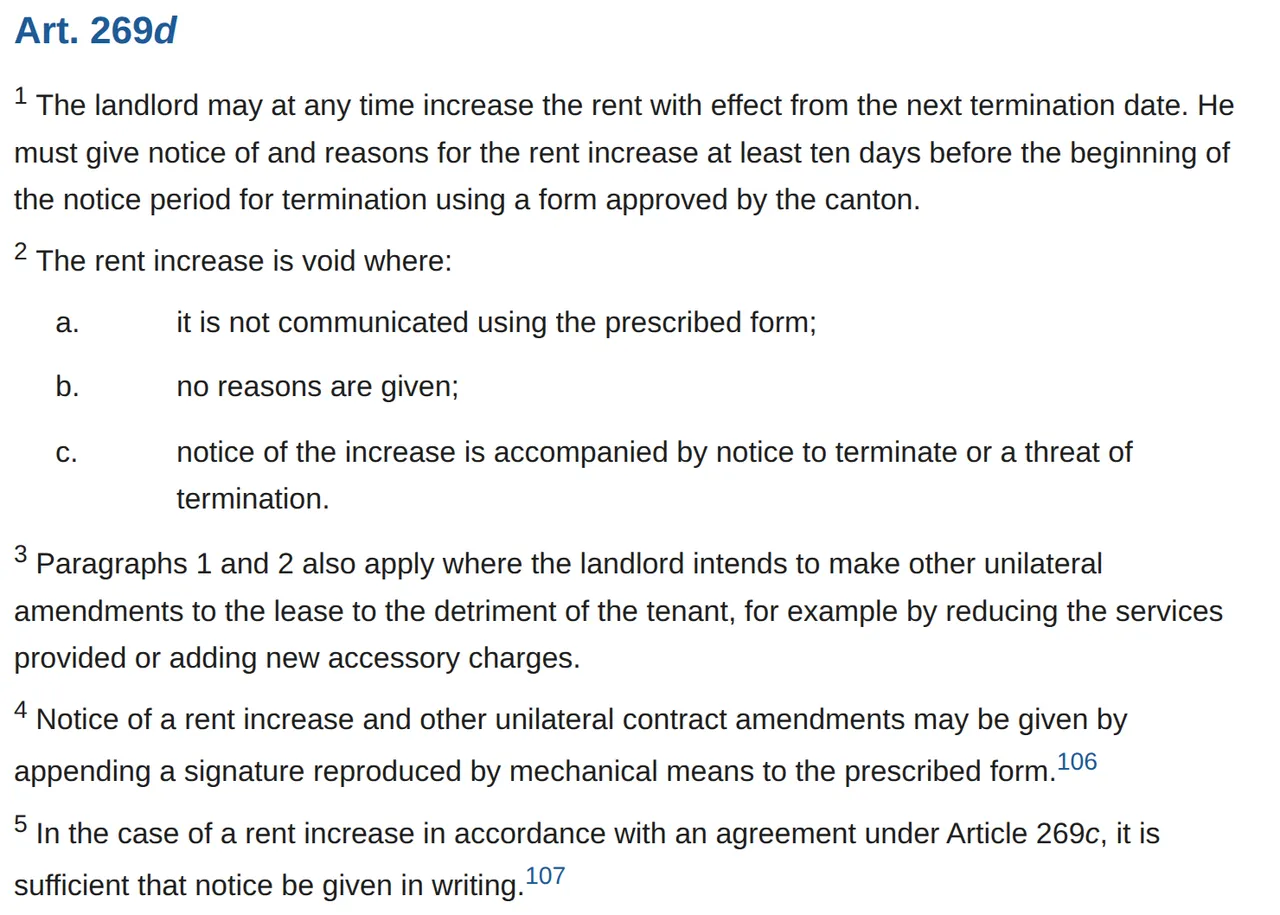
Check the paperwork first and the figure second. The law names three mistakes that make an increase void: it does not come on the form approved by the canton, it gives no reasons, or the landlord uses the notice to threaten termination or to terminate the lease outright. That is what art. 269d of the Code of Obligations (CO) says.
Void means the increase does not apply, and there is no deadline for you to meet. The Zurich courts (in German) describe such an increase as ineffective even without a challenge. A letter on company letterhead, an email or a sentence in the ancillary costs statement is therefore not enough. If you are not sure whether a defect is really that serious, challenge the increase within 30 days anyway. It costs nothing and protects you in case the authority sees the mistake differently.
What the form must contain is set out in art. 19 VMWG, the federal ordinance on tenancy law (not available in English): the current and the new rent including ancillary costs, the date from which the increase applies, and clear reasons. If the landlord gives several reasons, each one needs its own amount. A "hotchpotch of every possible adjustment criterion" is not allowed, the Zurich courts write. If the reasons are in a covering letter, the form must refer to it explicitly. For investments, it must say whether the landlord receives subsidies. On top of that come a notice of your rights and the list of conciliation authorities.
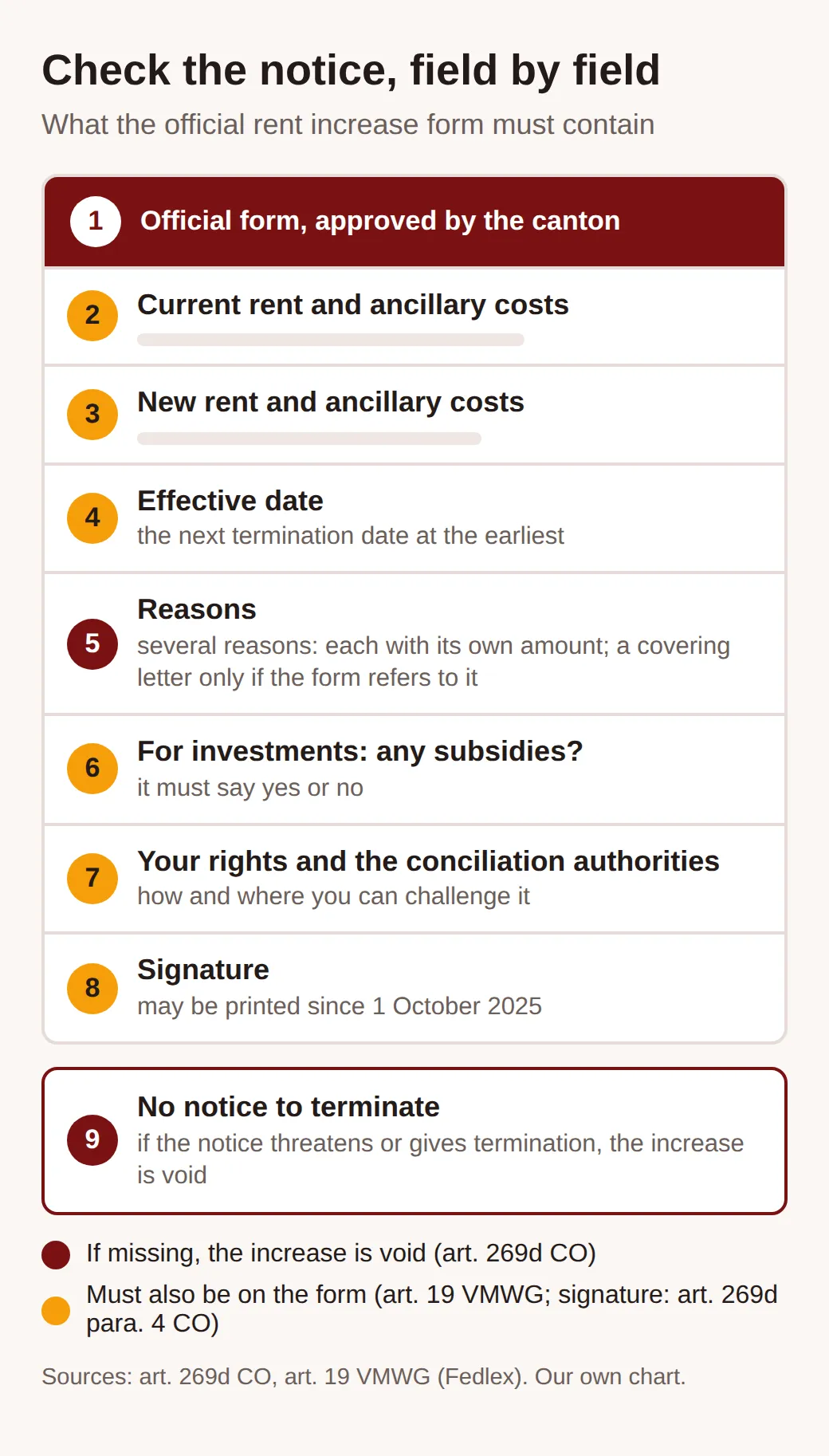
The rules on the signature have changed. Since 1 October 2025, a printed or otherwise mechanically reproduced signature on the form is enough. A missing handwritten signature is no longer an argument.
Finally, check the date. The landlord may only raise the rent with effect from the next possible termination date, and the form must reach you at least ten days before the notice period begins. During a fixed-term lease an increase is generally ruled out, except for index-linked and stepped rents. If the form arrives too late, the increase only applies from the termination date after that, according to the Zurich courts. You still have to challenge it within 30 days, and that deadline deserves a close look.
When do the 30 days start?
On the day after you receive the increase. If it comes by ordinary post, or if you sign for the registered letter at the door, the case is clear. It gets trickier if you are not at home and find a collection slip in your letterbox.
For rent increases, a special rule then works in your favour. Here the Federal Supreme Court applies what is called the relative theory of receipt (BGE 140 III 244, consideration 5.1): the increase counts as received when you collect the registered letter at the counter, or at the latest on the seventh and last day of the collection period. For a notice to terminate the rule is stricter: there the letter usually counts as received at the latest on the day after the collection slip was left. That is why the Zurich courts advise landlords to send an increase by registered post at least 20 days before the notice period begins, since they bear the risk of the letter sitting at the post office.
The days are counted under art. 77 CO: the day of receipt does not count, and day 30 is the last day. If it falls on a Saturday, a Sunday or an official public holiday, the deadline ends on the next working day (art. 78 CO). There is also a trap at the end of the year. The court holidays from 18 December to 2 January do not apply to conciliation proceedings (art. 145 of the Civil Procedure Code, CPC). Yet an increase for a termination date at the end of March has to reach you in December at the latest, because flats have three months' notice, and then the 30 days fall exactly into that period.
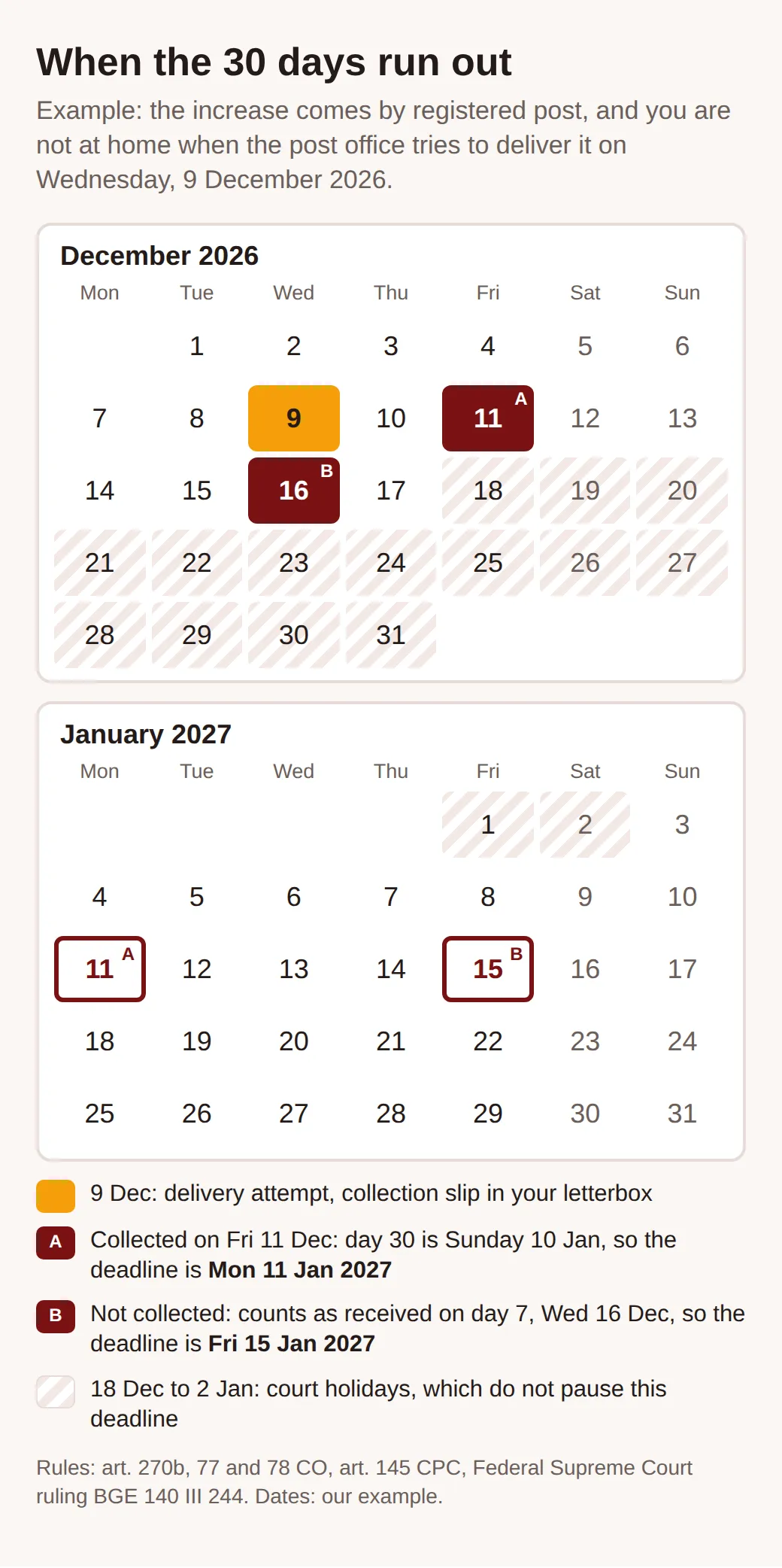
In the example, only four days separate the two cases. Even so, do not rely on the last possible day. To be completely safe, count from the day after the collection slip was left, in the example from 10 December, which also takes you to Monday, 11 January. Send your application with a few days to spare, and write down the date you collected the letter, ideally on the envelope itself.
Two more things do not stop the clock. If the increase is based on costs or investments, you may ask the landlord to back up the amount with figures. But the 30-day deadline for a challenge is "not affected" by that, as art. 20 VMWG states. A conversation with the property manager does not stop anything either. If you are waiting for an answer, file a challenge as a precaution and withdraw it if you reach an agreement. You can withdraw at any time, says the Swiss tenants' association, the Mieterinnen- und Mieterverband (in German). Whether a challenge is worth it depends on the reason the landlord gives.
Which reasons hold up in 2026
An increase is allowed as long as it is not unfair. Art. 269a CO lists what is generally not unfair: higher costs, additional services from the landlord, offsetting inflation and, with restrictions, the rents customary in the locality or district. The starting point is the last time your rent was bindingly set, meaning your lease, the last increase you did not challenge, or a settlement. That is set out in the fact sheet of the Zurich conciliation authorities (in German). Reasons may be combined, but each one has to stand up on its own.
Reference interest rate: no reason at 1.25 percent
If the reference interest rate rises by a quarter of a percentage point, the net rent may go up by 3 percent (art. 13 VMWG). But it has not risen. The Federal Office for Housing (in German, French and Italian) confirmed it at 1.25 percent on 1 September 2026, where it has been since 2 September 2025. In the table published by the journal mietrechtspraxis, which goes back to 2018, not a single value is lower. So a rent based on 1.25 percent cannot be raised on the strength of the reference rate while it stays there, and a rent based on a higher rate even less so.
If your rent is still based on 1.50 or 1.75 percent, you would in fact be entitled to a reduction. The tenants' association calls challenging an increase "the last opportunity" to put right a reduction you missed, because otherwise the increased rent becomes the new basis. Our article on the reference interest rate and rent reductions shows how to work out that claim.
Inflation: 40 percent, not 100
The rent may rise by at most 40 percent of inflation, measured by the Swiss consumer price index (art. 16 VMWG). The formula of the Zurich conciliation authorities is: new index level minus old index level, times 40, divided by the old index level. According to the tenants' association, the old level is usually the one for the month before the lease was signed or before the last increase, and the new level is the one for the month before the notice. Both have to be on the same index base.
An example: in January 2026 you signed a lease for a net rent of CHF 1,600. The index that counts is the one for December 2025, which is the Federal Statistical Office's new base, so exactly 100 points. In September 2026 it stood at 101.5 points. That gives 1.5 times 40 divided by 100, so 0.6 percent, or CHF 9.60 a month.
Higher costs: proven or as a flat rate
The landlord may also pass on higher fees, insurance premiums and maintenance costs (art. 12 VMWG). In principle they have to prove that these costs have gone up. To keep things simple, the Zurich conciliation authorities use flat rates per year: 0 percent for new buildings up to five years old, 0.25 percent if many ancillary costs are billed separately, and 0.5 percent if few or none are. In court a flat rate is only enough in exceptional cases; there, receipts are needed. Other cantons sometimes calculate differently, so ask your conciliation authority.
In the example, with ancillary costs paid as a flat fee, that would be 0.5 percent for the nine months from December 2025 to September 2026, so 0.375 percent or CHF 6. Together with inflation, the rent may therefore rise by CHF 15.60. If the landlord asks for CHF 80 "because of inflation and higher costs", CHF 64.40 of it is more than these two reasons allow.
Investments: only the added value counts
A new kitchen, new windows or a solar installation justify an increase if they improve the flat (art. 14 VMWG). But the landlord may only pass on the part that goes beyond replacing the old. For a comprehensive overhaul, 50 to 70 percent of the costs usually count as adding value. Subsidies have to be deducted, and the landlord may only announce the increase once the work is finished and the invoices are in.
The amount is made up of depreciation, interest and maintenance. The Zurich courts calculate it like this: 100 divided by the lifespan in years, plus half of the sum of the reference rate and a 2-point surcharge, plus 1 percent for maintenance. Their own example is a CHF 1,000 dishwasher where there was none before, with a lifespan of 15 years. At a reference rate of 1.25 percent that gives 6.67 plus 1.625 plus 1 percent, so CHF 92.90 a year or CHF 7.75 a month. The lifespan of individual fittings is in the joint lifespan table of the tenants' and homeowners' associations. Ask for the statement of costs and check whether it includes plain maintenance, such as a new coat of paint.
Comparable rents, reservations and returns
According to the tenants' association, a landlord can generally only raise the rent during a tenancy on the basis of rents customary in the locality or district if the lease contains a reservation to that effect. Without one, it is only possible in exceptional cases, when a long time has passed since the rent was last set, and then the landlord has to prove the comparable rents. If the landlord held back part of an earlier adjustment, they had to record that reservation in francs or as a percentage (art. 18 VMWG). If they are using it now, you can challenge it.
You can also object that the increase would give the landlord an excessive return. According to the Zurich courts, this objection is a defence against an increase based on the reference rate, inflation or costs. But it needs figures on the property that tenants rarely have. The Zurich tenants' association recommends getting advice for it. Once you have your reasons together, the application comes next.
How to write the application for conciliation
The application goes to the joint conciliation authority for tenancy matters where the flat is, not the one where the landlord is based. The form for the increase names the authority responsible. Your application names the other party, what you are asking for and what the dispute is about (art. 202 CPC). You can submit it in writing or make it orally at the authority and have it recorded. The proceedings are held in the official language of the canton (art. 129 CPC), so write in German, French or Italian, not in English. Many authorities have their own templates. The Zurich courts, for example, offer an online form (in German) that asks for the date you received the notice and for the rent you consider correct.
According to the tenants' association, everyone named in the lease has to sign, and for a family home both spouses. Enclose copies of the lease, earlier rent changes, the notice you are challenging and your correspondence with the property manager. Send the application by registered post. In short, it could read like this (in English here; yours goes in the canton's language):
Challenge of a rent increase under art. 270b CO
Applicant: [name, address]. Respondent: [landlord or property manager, address].
By a form dated [date], received on [date], the respondent is raising the net rent of my flat at [address] from CHF [amount] to CHF [amount] with effect from [date]. I challenge this increase as unfair and ask that the net rent be set at no more than CHF [amount].
Reasons: [for example: inflation and higher costs justify no more than CHF 15.60. The rent is based on a reference rate of 1.50 percent; the rate that applies is 1.25 percent.]
Enclosures: lease, increase form, earlier adjustments. Place, date, signatures of all tenants
What happens at the conciliation authority
The authority sends your application to the landlord and summons both sides. The hearing is meant to take place within two months (art. 203 CPC). You have to attend in person, but you may bring a person you trust or a lawyer (art. 204 CPC). If you do not turn up, your application is deemed to have been withdrawn (art. 206 CPC). In tenancy disputes, conciliation proceedings cost no court fees, and neither side is ordered to pay the other's costs (art. 113 CPC).
Until the proceedings are over, your existing lease carries on unchanged (art. 270e CO). So you pay the old rent. If you reach an agreement, the matter is settled. If not, the authority can make a proposed decision. If neither side rejects it within 20 days, it has the effect of a binding decision. If one side rejects it, that side receives the authorisation to proceed and has to go to court itself; otherwise the proposal counts as accepted (art. 211 CPC).
If there is neither an agreement nor a proposal, it is the landlord who receives the authorisation to proceed when a rent increase is challenged (art. 209 CPC), and they have 30 days to file a claim. The burden of going to court is therefore on them, not on you. That is one reason why a challenge carries little risk for tenants.
That leaves the fear of being given notice. A notice to terminate given because you assert claims in good faith, or because the landlord wants to push through a rent change, can be challenged. The same goes for a notice given during the proceedings and for up to three years afterwards if the landlord lost a substantial part of the case, backed down or reached a settlement with you (art. 271a CO). The protection is not absolute, for example in the case of rent arrears or the landlord's urgent need to use the property.
Index-linked rents, stepped rents, ancillary costs: the special cases
Not every rent change follows the rules above. With an index-linked rent, which requires a lease of at least five years, the only argument you can make before the conciliation authority is that the change in the index does not cover the increase (art. 270c CO). A stepped rent, where the increases in francs are written into the lease, cannot be challenged at all; only the initial rent can (art. 270d CO). For notice of such a step, a simple letter is enough.
New ancillary costs or fewer services from the landlord, on the other hand, are unilateral changes to the lease. The same rules apply to them as to an increase: official form, reasons, challenge within 30 days. Whether the ancillary costs themselves are billed correctly is a separate question, which we cover in our article on the ancillary costs statement.
What to do now
First, write down when you received the notice and work out day 30. Then check the form against the nine points, get out your lease and the last adjustment, and read off the reference rate and the index level there. Recalculate each reason given, one by one, with the Zurich courts' rent calculator (in German) or the tenants' association's own.
If you are still in doubt, challenge it: you can withdraw an application at any time, but a missed deadline cannot be fixed. The Federal Office for Housing next publishes the reference rate on 1 December 2026. If it rises at some point, an increase on that ground can be justified again, and then it is all the more worth checking the sums.
Common questions
What if the rent increase notice arrived too late?
It is not simply invalid. If the form arrives less than ten days before the notice period begins, the increase only applies from the termination date after the next one. If you do not agree with the amount, you still have to challenge it within 30 days of receiving it.
Can I challenge only part of a rent increase?
Yes. In your application you state the rent you consider correct, for example the old rent plus the share for inflation. The form of the Zurich conciliation authorities has a separate field for it.
I live in a subsidised flat. Can I challenge a rent increase?
Not in quite the same way. If a public authority controls your rent, the Swiss tenants' association says you challenge an increase with the office that controls the rents, not with the conciliation authority. The rent on such flats does not follow the reference interest rate either. If in doubt, ask the property manager which office is responsible before the 30 days are up.
Do I have to accept higher advance payments for ancillary costs?
No, as long as the landlord only asks for your agreement in a letter: that is an offer you can accept or turn down. If the change comes on the official form, it is a unilateral change to your lease, which you can challenge within 30 days like a rent increase. If you have had to pay large balances on your annual statement in recent years, a higher advance payment may still make sense.
More from the blog
All posts
Minimum temperature in a Swiss rented flat: your rights
No legal minimum temperature, just reference values: 20 °C living room, 17 bedroom, 23 bathroom. What they mean for tenants and what to do if it stays cold.

Flat handover in Switzerland: defects list, deadline, photos
Moving into a rented flat in Switzerland: what goes in the move-in report, when to send your defects list and which photos save you money at move-out.

How to challenge a landlord's notice in Switzerland
Notice from your landlord? You have 30 days from the collection slip. Void without the official form, set aside if abusive, extensions of up to four years.